 |
| Figure 1. Map of the Cripple Creek mining district. A red arrow points to the town of Independence. The Vindicator mine is almost due south of the town of Independence. The Independence mine is northeast of Victor. Modified from Jameson, 1998. |
Independence was a place where miners and their families lived, and by 1896, the population reached 500 (MacKell, 2016). An active business district along Montgomery Avenue included of an assayer, jeweler, photographer, and one doctor (MacKell, 2003). There was a drugstore, grocery, meat market, bakery, barber shop, two saloons, and a lumber mill. According to the newspaper, Mrs. Marshall “set a good table” at her restaurant (The Morning Journal, February 27, 1895). Willard F. French ran an active assay office in town. Independence also had a boardinghouse and two hotels (MacKell, 2016). Mrs. Mamie Crook’s Hotel Montgomery offered a “Nice home for miners, good board and clean rooms at reasonable rates” (MacKell 2016). The Independence Retort published a weekly newspaper.
The Midland Terminal Railway stopped at the modest depot on First and Montgomery to handle freight and passenger traffic (MacKell, 2003). While the railroad built the depot, the station agent lived in a nearby box car (The Morning Journal, December 13, 1894). While laying tracks toward the depot, the railroad made a cut in the ground on the property of the Longfellow mine number 2 and exposed a gold vein. The cut was near where the depot was to be built. Owners of the claim picked up some pieces of rock from the vein and threw them into the firebox of a nearby locomotive. The rock came out of the fire blistered with gold. Within five days, miners had dug a carload of ore (The Morning Journal, December 19, 1894). Station agent Jackson of the Midland Terminal depot at Independence later became a joint owner of the lease on the Longfellow number 2. Newspapers later reported of several gold strikes there. The Florence and Cripple Creek Railroad also had a depot in Independence (figure 7).
Accidents and injuries were not uncommon at the railroad depots in Independence. In one example, a moving train struck a Mr. Adams near the main Independence depot about 6:30 pm on Tuesday, June 20, 1899. Adams was from Pueblo and was on an excursion to the mining district. He was taken to the Sisters’ Hospital in Cripple Creek and died that evening (The Morning Journal, June 20, 1899).
Saloons did a brisk business in Independence. The Morning Journal reported this unusual story: “John Lamb of Independence, commenced a suit in district court to recover money lost by him in an Independence gambling hall. The defendants in the case are Charles Zeigler and Charles Cunningham. Lamb alleges in this complaint that while on his way home from work he dropped into the gambling hall and saloon of the defendants and after being given a drink or two by them his brain was so stupefied by the drink and drugs that he did not know what he was doing. He alleges that the defendants then induced him to play a game of chance, and he lost $117 . Scott Ashton, of Victor, is the plaintiff’s attorney” (The Morning Journal, August 15, 1899).
Independence was likewise the location of a large ore loading rail yard. Locomotives made it a noisy place, with their pistons chuffing, whistles blasting, and brakes screeching. Switch engines and crews traveled around to the various mines and mills and switched ore cars out—pulling the loaded ore cars away and replacing them with empty cars. The switch crew would then assemble loaded ore cars into a train that hauled the ore to a mill for treatment. People in town surely would have noticed the heavy rumbling of a train as it rolled by, pulling loaded ore cars. They watched locomotives that ran through the area, belching plumes of heavy black smoke, soot, and cinders. The air smelled of coal and hot valve oil, and the wooden railroad ties reeked of creosote.
Figure 2 shows the Midland Terminal Railway engine number seven, with its switch crew taking a break at the town of Independence in 1904. The photograph also reveals the dual gauge track and extra link-and-pin coupler socket on the engine, allowing it to handle either standard or narrow-gauge equipment. The coupler—for narrow gauge cars—was offset, while the standard gauge coupler was centered (the coupler can be clearly seen above the “cowcatcher” in figure 2). Both the Midland Terminal and the Colorado Midland were standard gauge, but other railroads in the district were narrow gauge.
 |
Figure 2. Switch engine and its crew in Independence, Colorado. Hull City mine in the background. Photo date 1904 by an unknown photographer. From the Joata (Osborn) Bottcher collection. Courtesy of the Cripple Creek District Museum, CCDM A8524.
|
Independence continued to grow, and by 1899, 1,500 people called it home (Sprague, 1953). The town crowded around two important mines, the Vindicator and the Hull City mine.
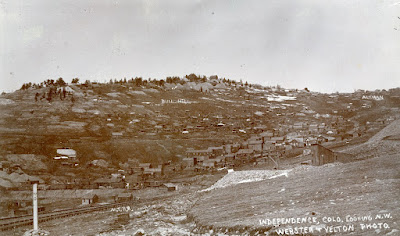 |
| Figure 3. The town of Independence, Colorado, looking northwest. Photo date 1897. Webster and Yelton photographers. Courtesy of the Cripple Creek District Museum. CCDMA82. 329A. |
The Vindicator mine was in the Montgomery gulch section of this small gold-rush town. It was a steady producer, and by 1907, The Mining Investor reported the mine had almost 25 miles of underground workings and had distributed, in total, over $1.7 million in dividends to stockholders (The Mining Investor, March 2, 1908). By 1910, the Vindicator was the fourth largest producer in the district, employing 350 miners who worked there.
The rich Hull City mine, which covered an area of 39 acres, was within the town limits (Lindgren and Ransome, 1906). According to Lindgren and Ransome (1906) the “Hull City had a complex vein system where calaverite, the main ore mineral, coated narrow seams in these veins. Quartz and fluorite coated small vug holes.” By the end of 1899, the mine had produced $900,193 in gold, and during the next three years (January 1, 1901 to January 1, 1904) generated gold worth $999,174 (Lindgren and Ransome, 1906).
 |
| Figure 4. The town of Independence with the Hull City mine (foreground) and the Vindicator mine. Library, The State Historical Society of Colorado. CCDM A82-132. |
By 1906, the Hull City’s main shaft reached a depth of 1,265 feet, with 11 levels; a second shaft, the King shaft (sometimes called the Vaughn or Glorietta shaft) was 860 feet deep, with 12 levels. This King shaft was in operation near the southern boundary of the mine (Lindgren and Ransome, 1906).
The record of accidents and deaths miners suffered at the Hull City mine is incomplete. The Aspen Weekly Times reported that an explosion killed James Drury in the lower stopes of the mine on June 4, 1901. According to the reporter, “He was warned before going into one of the stopes that one of the shots had failed to explode but went on and drilled into the blast. The entire side of this head was blown away” (The Aspen Weekly Times, 1901). Another mine accident killed A. M. Mellon on the morning of April 5, 1902, as he rode in a cage in the Hull City shaft. When he carelessly stuck his head out from the cage, a passing timber crushed his skull and snapped his neck. He had no relatives (The Telluride Journal, 1902). Records show that rocks from a bucket dropped on John Williams, killing him (Sherard, 2006). The nearby Vindicator injured and claimed the lives of an unknown number of miners. The true extent of these grim statistics for the Vindicator and the Hull City mines will remain largely unknown.
 |
| Figure 5. Early photo of Independence. Mining operations dot the landscape. Photographer and date unknown. Courtesy of the Cripple Creek District Museum. CCV93GKCCM WA. |
Cripple Creek was a Western Federation of Miners union stronghold, and a crisis arose on August 8, 1903, when Cripple Creek union miners walked out in support of the striking smelter workers in Colorado City, Colorado (Taylor, 2003). The issue was over hours worked each day and pay. By August 11, at least 3,500 men had quit work in 50 of the district’s mines (Jameson, 1998)..The district soon became a battlefield, with confrontations between labor, employers, and the state of Colorado. About that same time, the district’s labor wars spilled over into the town of Independence. The disputes resulted in injuries and loss of life. Harry Orchard, who resided in Independence, became embroiled in the district’s labor strife, and committed several acts of violence. On November 21, 1903, a bomb set by Orchard exploded on the sixth level of the Vindicator mine, killing superintendent Charles H. McCormick and shift boss Melvin H. Beck, who were inspecting the mine (Orchard, 1907; Annual Report for the Vindicator, 1903).
 |
| Figure 6. Harry Orchard, whose real name was Albert Edward Horsley, lived in Independence and left behind a bloody trail in the Cripple Creek Mining District. Photo courtesy of the Cripple Creek District Museum. |
About six months later, Orchard, with the help of Steve Adams, placed between 150 and 200 pounds of dynamite under a loading platform at the Florence and Cripple Creek Railroad depot in Independence (Jameson, 1998; Sprague, 1953). On June 6, 1904, at 2:15 am, while a crew from the Findley mine waited for a train, the bomb exploded. The blast blew one miner 150 feet away from the depot, killed 13 miners, and injured another 20. Orchard and Adams covered the soles of their shoes with kerosene, so the sheriff’s bloodhounds could not track them, and disappeared into the darkness. Colorado’s lieutenant governor declared the county in a state of insurrection and mobilized the National Guard (Jameson, 1989).
The strike lasted for fifteen months before finally coming to an end. Thirty-three people were killed, but organized labor lost out as a result of determined opposition by mine owners and the state of Colorado. With no further union representation in the district, miners worked under the tight control of mine owners (Taylor, 2003).
Harry Orchard was later convicted of blowing up the former governor of Idaho, Frank Steunenberg, in 1905. Facing the death penalty, Orchard confessed to the murder of the former governor and 16 other people. Orchard died in the Idaho state penitentiary April 13, 1954, at the age of 88.
 |
| Figure 7. The Florence and Cripple Creek depot in Independence after Harry Orchard blew it up on June 6, 1904. Courtesy of the Cripple Creek District Museum. CCDM 82 420. |
More commotion would come to Independence on February 11, 1906, when two masked gunmen robbed the Silver Bell Saloon. A gun battle broke out that killed one robber, while the other outlaw fled packing $1,800 in cash (MacKell, 2016).
After the district’s labor wars ended, Independence’s population shrank. Records reveal that, in 1919, 500 people remained in town. The town’s population continued to dwindle as gold mining declined. Its post office closed in 1954, and the Hull City mine ended operations in 1958. A handful of people remained for a few years after that, but then the town nearly disappeared—melting into thin air. Today, only a few ramshackle historic structures survive.
Acknowledgments
I thank Ben Elick for modifying the map used in this paper. I thank the Colorado Springs Oyster Club and Dr. Bob Carnein for their critical reviews.
References and further reading
Annual Report for the Vindicator Consolidated Gold Mining Company, 1903.
Jameson, E., 1998, All That Glitters: Class, Conflict, and Community in Cripple Creek: Chicago. University of Illinois Press.
Lindgren, W., and F. L. Ransome, 1906, Geology and Gold Deposits of the Cripple Creek District, Colorado: Washington, Department of the Interior, U.S. Geological Survey Professional Paper No. 54.
MacKell, J., 2003, Cripple Creek District: Last of Colorado’s Gold Booms: Charleston, Arcadia.
MacKell, J., 2016, Lost Ghost Towns of Teller County: Charleston, History Press.
Orchard, H, 1907, The Confessions and Autobiography of Harry Orchard: New York, The McClure Company.
Sherard, G. 2006, Colorado Mine Accident Index: Fatal and Non-Fatal, Retrieved from https://history.denverlibrary.org/sites/history/files/ColoradoMiningAccidents.pdf, on January 21, 2022.
Sprague, M., 1953, Money Mountain: The Story of Cripple Creek Gold: Lincoln, University of Nebraska Press.
Taylor, R.G., 2003, Cripple Creek Mining District: Palmer Lake, CO, Filter Press.
Aspen Weekly Times, June 8, 1901, p. 3.
The Morning Journal, Oct 28, 1894, p. 1.
The Morning Journal, December 13, 1894, p. 8.
The Morning Journal December 19, 1894, p. 3.
The Morning Journal, February 27, 1895, p. 1.
The Morning Journal, June 20, 1899, p 4.
The Morning Journal, August 15, 1899, p. 4.
The Morning Journal, December 26, 1899, p. 94.
The Mining Investor, March 2, 1908, p. 70.
The Telluride Journal, April 10, 1902, p. 6.


