Showing posts with label Cripple Creek Mining District. Show all posts

Sunday, August 6, 2023

Bolts of Tragedy: A Teen's Fatal Encounter in the Cripple Creek Mining District

 By Steven Wade Veatch


            On a fateful Wednesday, July 15, 1914, 13-year-old John F. Bowen visited his friends at the Kilpatrick Ranch near Gillette, Colorado. It started out like any other day for John—his past behind him, his future ahead, but unlike other days, this would be his last day on Earth.

Young John Bowen had lived an eventful life. He was born in Leadville on January 12, 1901, to Irish parents. John and his family lived in the Big Stray Horse Gulch in Leadville. His father, Thomas, worked in a Leadville silver mine. Certainly, his father had heard about the roaring Cripple Creek Mining District while working in Leadville. Unable to resist the lure of the Cripple Creek goldfields, Thomas gathered up his family and moved to the “World’s Greatest Gold Camp.” By 1905, he was working as a miner at the Free Coinage Mine and lived in Altman, one of the mining camps in the district (Cripple Creek City Directory, 1905).

A mine headframe in the gold mining district.
The author created this AI image
with the assistance of DALL·E and MS Bing.

On that fateful Wednesday, John prepared to visit friends at the Kilpatrick Ranch, near Gillette, Colorado. When it was time to leave for Gillette, he no doubt kissed his mother, Mary, goodbye, waved to his siblings, and shook hands with his father, who was, by now, the town marshal. John quietly stepped through the door, went outside, and stood beside his donkey—ready to ride. He then hoisted himself onto the donkey's back, adjusted his grip on the reins, and gave a gentle kick. The donkey responded to John’s command, and with the donkey’s cautious step forward, they began their descent down a winding mountain road. He passed by several of the big gold producers (the Burns, Pharmacist, and Zenobia mines) in the Cripple Creek District.

Main Street (Baldwin Avenue) in Altman.
Photo date unknown. Courtesy of the Cripple Creek District Museum. 

Soon the mountain trail stretched out before them, snaking through lush greenery, wildflowers, aspens, and spruce trees. Sometimes long grass brushed against his trousers as he rode. His heart raced with excitement at the rhythmic sound of the donkey's hooves echoing through the crisp mountain air.

John’s hands gripped the reins firmly as the sure-footed donkey worked its way down the mountain with a steady gait. At times, the trail presented challenges—a steep incline, a narrow passage between rocks, and a bend in the road that made John lean into the curves, shifting his weight to aid the donkey's balance. Nature seemed to come alive around him. John noticed deer, hawks, and squirrels in the foliage, and each sight added to the thrill of the ride.

As they rode to Kilpatrick's Ranch, John felt the wind tousling his hair and smelled the scent of pine and earth in the air. Finally, the road brought him to a peaceful clearing—Kilpatrick’s Ranch—below Pikes Peak.

Perhaps his day can be thought of in this way: By the time he arrived at the ranch, the sun was high in the open sky as a group of teenage boys gathered at the corral. John dismounted and patted the donkey affectionately. The boys greeted one another with laughter and handshakes. The ranch, with its pastures, trails, ponds, and pine trees, promised endless possibilities. The boys reveled in the freedom that came with riding horses as they explored the sprawling landscape, galloped through open fields, and maneuvered around trees, rocks, and other obstacles.

As the afternoon ended, it was time for John and the donkey to head for home. John bade farewell to his friends, mounted his donkey, and started riding back home to Altman. He carried with him the memories of a day well spent on the ranch with his friends. The way back was uphill, and after a while, John dismounted and sat on a flat, lichen-encrusted stone to give his donkey a break. A storm seemed to be gathering.

As John and his donkey approached Altman (the camp with the highest elevation in the district) a storm developed. The sky roared with a primal fury as jagged bolts of lightning split the heavens and illuminated the darkness with their dazzling brilliance. Thunder reverberated through the air and a rumbling percussion shook the ground. Gusting winds whipped through the trees. The air crackled with raw energy, charging the atmosphere with electric tension. Nature's power was on full display, revealing unpredictable might.

Just as John and his donkey were nearing Altman, lightning stretched across the sky from hell to breakfast, and struck a nearby tree, causing it to explode. Newspaper accounts record what happened when he was close to home. The Rocky Mountain News published this incredible report on July 16, 1914:

He had visited the Kilpatrick ranch nearer Gillette and was returning to his home when he encountered an electrical storm. He had proceeded within a half mile of his home when a bolt of lightning struck a tree near the road. Rider and animal were felled by the effect of the bolt. Young Bowen was strapped securely in the saddle and when the burro arose later the limp form of the boy clung to the animal. The burro continued until he reached the yard of the Bowen home where the mother of the boy loosened him from the saddle and carried him into the house.

            Members of the Bowen family worked over the boy several minutes before he was revived. He became hysterical and asked strange questions. The family sought to calm him but failed.

            An hour after he had been brought into the house, young Bowen walked to a bureau, pulled out a gun, which was small caliber, and fired into his body above the heart, dying almost instantly.

            The shooting was witnessed by members of the family, but they were unable to reach the boy in time to prevent him from ending his life. The remains were turned over to the coroner (Youth Crazed by Lightning, 1914).

Lightning is a formidable force. It is possible that lightning struck John in this way: When lightning struck the tree, it jumped to John Bowen as well (Auerbach, 1980). John would have felt its impact through multiple systems of his body. Neurologic complications could have been severe, including loss of consciousness, confusion, memory issues, dizziness, headaches, seizures, and changes in sensation or movement. He would have suffered other problems, such as burns (from heat caused by the strike) and associated blunt trauma from explosive shock waves (Fontanarosa, 1993). Objects damaged or thrown by a lightning strike can cause physical injury. The only thing known for sure is that John was not the same after the lightning strike. His eyes finally opened, he gulped in some fresh air, got up, walked to a chest of drawers, opened a drawer, picked up a revolver, and shot himself.

John Bowen, a spirited teen boy, riding his donkey back to his home in Altman.
Rain started as the clouds grew darker. The author created this AI image
with the assistance of DALL·E and MS Bing.

John died at his home at the top of the hill. Time had slipped away from him, a life mostly unlived. The death of a teenage boy is a tragedy that makes us question our existence. It reminds us to appreciate the fragility of our time on Earth and appreciate the people around us.


John Bowen’s tombstone at the Sunnyside Cemetery,
Victor, Colorado.
Photo date 2023 by S. W. Veatch


References and further reading:

1905 Cripple Creek City Directory. Denver, CO: Gazette Publishing Company.

Auerbach, P. S., 1980, October. Lightning Strike. Topics in Emergency Medicine 2(3): p 129-136.

Fontanarosa, P. B., 1993, Electrical shock and lightning strike, Annals of Emergency Medicine, Vol. 22, Issue 2, Part 2.

Youth Crazed by Lightning, Sends Bullet into Body in Presence of Family., 1914, July 16. The Rocky Mountain News (daily), Vol. 55, No. 197.


Sunday, August 14, 2022

Underground

 By Steven Wade Veatch


Thunderstorms batter the sky.
The porch shakes while lightning wages war.
Black and purple mix like a bruise.
Wind whirls through the aspens.
Icy rain soaks the ground—
wet soil and decaying leaves
smell like an underground mine.
Dank scents bring memories
with annotations. My thoughts spin
then strike the borderland of my memories,
breaking through to a place
of shafts, dimly lit voids, and ore carts.
 
My great grandfather trudges
through confining spaces, groaning timbers,
dripping water, and rusting rails.
Muddy places smear his clothes with grime.
His pick bounces off rocks again and again.
Booming blasts fill the drifts with acrid
smells. A taste of sulfur lingers.
 
I see him reach down and scoop
up a handful of gold ore,
he lets it fall through his fingers,
and tells me how to live.
So much to remember.
I should have listened more,
but I am far away.
 
The blackness swallows
the flickering light of his candle
and his face recedes from view.
His words flood my mind—
a generational reckoning—
part of my ritual of becoming.
I carry some stories, like blaring bells,
others I have lost.
 
In me, these inheritances manifest:
a lifelong journey toward a glittering
horizon, but I never get there.
I should have listened more,
and now my time is gone.


Elkton mine, Cripple Creek Mining District. The author’s great grandfather worked in this mine for over two decades. Photo date 1894, courtesy of the Cripple Creek District Museum.


Friday, February 25, 2022

Independence: A Troubled Town in the Cripple Creek Mining District, Colorado

By Steven Wade Veatch

    A troubled man, with a festering and poisoned mind, emerged from the shadows on a Saturday night, just five days before Thanksgiving, 1903. He went down the shaft of the Vindicator mine, a substantial gold producer in the town of Independence, one of more than a dozen camps in the Cripple Creek mining district of Colorado. While down in the mine, this man planted a device that would later explode, killing two men. He had hoped to kill more. This was not the last act of violence committed by the fanatic bomber known as Harry Orchard. He later planned another attack, one that would be more destructive and more lethal for the town of Independence. And there would be other incidents of mayhem: saloon fights, gunfights, railroad accidents, and injuries from mining. Independence was anything but a quiet town.

    First known as Hull’s Camp, the town was renamed by promoters after the storied Independence mine, which is 2.5 miles south of the townsite. According to The Morning Journal, Mr. W. S. Montgomery, one owner of the Hull City mine, said, “Yes, there will be a town at Hull’s camp and it will be known as Independence. The site of the new town is an admirable one, with plenty of water and well sheltered by the surrounding hills. It is the center of the most productive section of camp. The streets are now being laid off and already several large business firms have signified their intention of locating in the new town” (The Morning Journal, Oct 28, 1894). A group of town organizers formally platted Independence on November 11, 1894 (MacKell, 2016). 


Figure 1. Map of the Cripple Creek mining district. A red arrow points to the town of Independence. The Vindicator mine is almost due south of the town of Independence. The Independence mine is northeast of Victor. Modified from Jameson, 1998.

    Independence was a place where miners and their families lived, and by 1896, the population reached 500 (MacKell, 2016). An active business district along Montgomery Avenue included of an assayer, jeweler, photographer, and one doctor (MacKell, 2003). There was a drugstore, grocery, meat market, bakery, barber shop, two saloons, and a lumber mill. According to the newspaper, Mrs. Marshall “set a good table” at her restaurant (The Morning Journal, February 27, 1895). Willard F. French ran an active assay office in town. Independence also had a boardinghouse and two hotels (MacKell, 2016). Mrs. Mamie Crook’s Hotel Montgomery offered a “Nice home for miners, good board and clean rooms at reasonable rates” (MacKell 2016). The Independence Retort published a weekly newspaper. 

    The Midland Terminal Railway stopped at the modest depot on First and Montgomery to handle freight and passenger traffic (MacKell, 2003). While the railroad built the depot, the station agent lived in a nearby box car (The Morning Journal, December 13, 1894). While laying tracks toward the depot, the railroad made a cut in the ground on the property of the Longfellow mine number 2 and exposed a gold vein. The cut was near where the depot was to be built. Owners of the claim picked up some pieces of rock from the vein and threw them into the firebox of a nearby locomotive. The rock came out of the fire blistered with gold. Within five days, miners had dug a carload of ore (The Morning Journal, December 19, 1894). Station agent Jackson of the Midland Terminal depot at Independence later became a joint owner of the lease on the Longfellow number 2. Newspapers later reported of several gold strikes there. The Florence and Cripple Creek Railroad also had a depot in Independence (figure 7).
    Accidents and injuries were not uncommon at the railroad depots in Independence. In one example, a moving train struck a Mr. Adams near the main Independence depot about 6:30 pm on Tuesday, June 20, 1899. Adams was from Pueblo and was on an excursion to the mining district. He was taken to the Sisters’ Hospital in Cripple Creek and died that evening (The Morning Journal, June 20, 1899).

    Saloons did a brisk business in Independence. The Morning Journal reported this unusual story: “John Lamb of Independence, commenced a suit in district court to recover money lost by him in an Independence gambling hall. The defendants in the case are Charles Zeigler and Charles Cunningham. Lamb alleges in this complaint that while on his way home from work he dropped into the gambling hall and saloon of the defendants and after being given a drink or two by them his brain was so stupefied by the drink and drugs that he did not know what he was doing. He alleges that the defendants then induced him to play a game of chance, and he lost $117 . Scott Ashton, of Victor, is the plaintiff’s attorney” (The Morning Journal, August 15, 1899).

    Independence was likewise the location of a large ore loading rail yard. Locomotives made it a noisy place, with their pistons chuffing, whistles blasting, and brakes screeching. Switch engines and crews traveled around to the various mines and mills and switched ore cars out—pulling the loaded ore cars away and replacing them with empty cars. The switch crew would then assemble loaded ore cars into a train that hauled the ore to a mill for treatment. People in town surely would have noticed the heavy rumbling of a train as it rolled by, pulling loaded ore cars. They watched locomotives that ran through the area, belching plumes of heavy black smoke, soot, and cinders. The air smelled of coal and hot valve oil, and the wooden railroad ties reeked of creosote. 

Figure 2 shows the Midland Terminal Railway engine number seven, with its switch crew taking a break at the town of Independence in 1904. The photograph also reveals the dual gauge track and extra link-and-pin coupler socket on the engine, allowing it to handle either standard or narrow-gauge equipment. The coupler—for narrow gauge cars—was offset, while the standard gauge coupler was centered (the coupler can be clearly seen above the “cowcatcher” in figure 2). Both the Midland Terminal and the Colorado Midland were standard gauge, but other railroads in the district were narrow gauge. 

Figure 2. Switch engine and its crew in Independence, Colorado. Hull City mine in the background. Photo date 1904 by an unknown photographer. From the Joata (Osborn) Bottcher collection. Courtesy of the Cripple Creek District Museum, CCDM A8524.

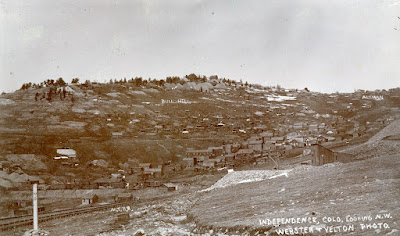
    Independence continued to grow, and by 1899, 1,500 people called it home (Sprague, 1953). The town crowded around two important mines, the Vindicator and the Hull City mine. 

Figure 3. The town of Independence, Colorado, looking northwest. Photo date 1897. Webster and Yelton photographers. Courtesy of the Cripple Creek District Museum. CCDMA82. 329A.

    The Vindicator mine was in the Montgomery gulch section of this small gold-rush town. It was a steady producer, and by 1907, The Mining Investor reported the mine had almost 25 miles of underground workings and had distributed, in total, over $1.7 million  in dividends to stockholders (The Mining Investor, March 2, 1908). By 1910, the Vindicator was the fourth largest producer in the district, employing 350 miners who worked there.

    The rich Hull City mine, which covered an area of 39 acres, was within the town limits (Lindgren and Ransome, 1906). According to Lindgren and Ransome (1906) the “Hull City had a complex vein system where calaverite, the main ore mineral, coated narrow seams in these veins. Quartz and fluorite coated small vug holes.” By the end of 1899, the mine had produced $900,193  in gold, and during the next three years (January 1, 1901 to January 1, 1904) generated gold worth $999,174  (Lindgren and Ransome, 1906). 

Figure 4. The town of Independence with the Hull City mine (foreground) and the Vindicator mine. Library, The State Historical Society of Colorado. CCDM A82-132.

By 1906, the Hull City’s main shaft reached a depth of 1,265 feet, with 11 levels; a second shaft, the King shaft (sometimes called the Vaughn or Glorietta shaft) was 860 feet deep, with 12 levels. This King shaft was in operation near the southern boundary of the mine (Lindgren and Ransome, 1906). 

The record of accidents and deaths miners suffered at the Hull City mine is incomplete. The Aspen Weekly Times reported that an explosion killed James Drury in the lower stopes of the mine on June 4, 1901. According to the reporter, “He was warned before going into one of the stopes that one of the shots had failed to explode but went on and drilled into the blast. The entire side of this head was blown away” (The Aspen Weekly Times, 1901). Another mine accident killed A. M. Mellon on the morning of April 5, 1902, as he rode in a cage in the Hull City shaft. When he carelessly stuck his head out from the cage, a passing timber crushed his skull and snapped his neck. He had no relatives (The Telluride Journal, 1902). Records show that rocks from a bucket dropped on John Williams, killing him (Sherard, 2006). The nearby Vindicator injured and claimed the lives of an unknown number of miners. The true extent of these grim statistics for the Vindicator and the Hull City mines will remain largely unknown.

Figure 5. Early photo of Independence. Mining operations dot the landscape. Photographer and date unknown. Courtesy of the Cripple Creek District Museum. CCV93GKCCM WA.

    Cripple Creek was a Western Federation of Miners union stronghold, and a crisis arose on August 8, 1903, when Cripple Creek union miners walked out in support of the striking smelter workers in Colorado City, Colorado (Taylor, 2003). The issue was over hours worked each day and pay. By August 11, at least 3,500 men had quit work in 50 of the district’s mines (Jameson, 1998)..The district soon became a battlefield, with confrontations between labor, employers, and the state of Colorado. About that same time, the district’s labor wars spilled over into the town of Independence. The disputes resulted in injuries and loss of life. Harry Orchard, who resided in Independence, became embroiled in the district’s labor strife, and committed several acts of violence. On November 21, 1903, a bomb set by Orchard exploded on the sixth level of the Vindicator mine, killing superintendent Charles H. McCormick and shift boss Melvin H. Beck, who were inspecting the mine (Orchard, 1907; Annual Report for the Vindicator, 1903).
Figure 6. Harry Orchard, whose real name was Albert Edward Horsley, lived in Independence and left behind a bloody trail in the Cripple Creek Mining District. Photo courtesy of the Cripple Creek District Museum.

    About six months later, Orchard, with the help of Steve Adams, placed between 150 and 200 pounds of dynamite under a loading platform at the Florence and Cripple Creek Railroad depot in Independence (Jameson, 1998; Sprague, 1953). On June 6, 1904, at 2:15 am, while a crew from the Findley mine waited for a train, the bomb exploded. The blast blew one miner 150 feet away from the depot, killed 13 miners, and injured another 20. Orchard and Adams covered the soles of their shoes with kerosene, so the sheriff’s bloodhounds could not track them, and disappeared into the darkness. Colorado’s lieutenant governor declared the county in a state of insurrection and mobilized the National Guard (Jameson, 1989).

    The strike lasted for fifteen months before finally coming to an end. Thirty-three people were killed, but organized labor lost out as a result of determined opposition by mine owners and the state of Colorado. With no further union representation in the district, miners worked under the tight control of mine owners (Taylor, 2003).

    Harry Orchard was later convicted of blowing up the former governor of Idaho, Frank Steunenberg, in 1905. Facing the death penalty, Orchard confessed to the murder of the former governor and 16 other people. Orchard died in the Idaho state penitentiary April 13, 1954, at the age of 88.

Figure 7. The Florence and Cripple Creek depot in Independence after Harry Orchard blew it up on June 6, 1904. Courtesy of the Cripple Creek District Museum. CCDM 82 420.

More commotion would come to Independence on February 11, 1906, when two masked gunmen robbed the Silver Bell Saloon. A gun battle broke out that killed one robber, while the other outlaw fled packing $1,800 in cash (MacKell, 2016). 

After the district’s labor wars ended, Independence’s population shrank. Records reveal that, in 1919, 500 people remained in town. The town’s population continued to dwindle as gold mining declined. Its post office closed in 1954, and the Hull City mine ended operations in 1958. A handful of people remained for a few years after that, but then the town nearly disappeared—melting into thin air. Today, only a few ramshackle historic structures survive.


Acknowledgments 
    I thank Ben Elick for modifying the map used in this paper. I thank the Colorado Springs Oyster Club and Dr. Bob Carnein for their critical reviews. 

References and further reading

Annual Report for the Vindicator Consolidated Gold Mining Company, 1903.

Jameson, E., 1998, All That Glitters: Class, Conflict, and Community in Cripple Creek: Chicago. University of Illinois Press.

Lindgren, W., and F. L. Ransome, 1906, Geology and Gold Deposits of the Cripple Creek District, Colorado: Washington, Department of the Interior, U.S. Geological Survey Professional Paper No. 54.

MacKell, J., 2003, Cripple Creek District: Last of Colorado’s Gold Booms: Charleston, Arcadia.

MacKell, J., 2016, Lost Ghost Towns of Teller County: Charleston, History Press.

Orchard, H, 1907, The Confessions and Autobiography of Harry Orchard: New York, The McClure Company.

Sherard, G. 2006, Colorado Mine Accident Index: Fatal and Non-Fatal, Retrieved from https://history.denverlibrary.org/sites/history/files/ColoradoMiningAccidents.pdf, on January 21, 2022.

Sprague, M., 1953, Money Mountain: The Story of Cripple Creek Gold: Lincoln, University of Nebraska Press.

Taylor, R.G., 2003, Cripple Creek Mining District: Palmer Lake, CO, Filter Press. 
Aspen Weekly Times, June 8, 1901, p. 3.

The Morning Journal, Oct 28, 1894, p. 1.

The Morning Journal, December 13, 1894, p. 8.

The Morning Journal December 19, 1894, p. 3.

The Morning Journal, February 27, 1895, p. 1.

The Morning Journal, June 20, 1899, p 4.

The Morning Journal, August 15, 1899, p. 4.

The Morning Journal, December 26, 1899, p. 94.

The Mining Investor, March 2, 1908, p. 70.

The Telluride Journal, April 10, 1902, p. 6. 

Wednesday, October 6, 2021

A Cripple Creek Profile: Frank Finegan and His Requa Savage Mine

 By Steven W. Veatch

Francis “Frank” Finegan (1835-1914) was an adventurer who fought in the Civil War. And he was among the first group to arrive at the goldfields of the Cripple Creek mining district, where he located and patented several mines. Stockholders elected him president, treasurer, and general manager of the Requa Savage when he incorporated the mine on April 26, 1894 (Colorado State Mining Directory, 1898). 


Figure 1. The Requa Savage mine. A miner, named “Big Swede," stands by an ore cart under the headframe of the mine. Photographer and date unknown. Courtesy of the Cripple Creek District Museum. CCDM A 8315.

Finegan left enough of a record to trace his interesting journeys and see the stormy corners of his life. He was born in 1835 in Loughrea, County Galway, Ireland. In 1854, he sailed out of Liverpool to New York City (Portrait and Biographical Record of the State of Colorado, 1899). He then left New York City and lived for a time in Hartford, Connecticut, where he worked as a stonecutter and mason. He moved to California in 1857 and mined on the American River, the site of the original 1848 gold discovery in California. One year later, he sailed to Australia and farmed near Ballarat. With three partners, he located a gold mine near there. The partners worked it until 1859, when they sold their interests, each pocketing $35,000—a whopping $1,091,375 in 2020 dollars (Portrait and Biographical Record of the State of Colorado, 1899). 

Finegan left Australia and returned to California for a few months in 1860. He then moved to New York City. On April 12, 1861, at 4:30 am, while Finegan was fast asleep, Confederate General Beauregard ordered his gunners to open fire on Fort Sumter, South Carolina. Cannons roared like a crack of thunder. Explosions lit up the darkness and smoke settled over the fort. Thirty-four hours later, the besieged Union garrison raised a white flag and surrendered. The Confederates committed an act of war that forced President Abraham Lincoln to act. Two days later, Lincoln called for volunteers to fight in a war to preserve the Union. 

Finegan answered Lincoln’s call. He joined the 69th New York Regiment that month and was mustered into service for three months. The 69th Regiment was part of the Irish Brigade, which at the beginning included the 63rd, 69th, and the 88th New York Regiments and the 28th Massachusetts Regiment. The 116th Pennsylvania Regiment, made up of Irishmen from Philadelphia, was added during the fall of 1862 (R. Sauers, personal communication). The Irish Brigade quickly built a reputation for fierce fighting on the battlefield, and Finegan found a passage into hell when he fought in many of its engagements.

The 69th New York Regiment fought in the First Battle of Bull Run under the command of General William T. Sherman. During that battle, Confederate forces took Finegan prisoner. The Confederates released him on parole (Both sides had no means to take care of prisoners; Grant later stopped the practice of releasing prisoners). Once released, Finegan reenlisted for three years and returned to the battlefield. 

Finegan saw combat at the Battle of Fair Oaks (Henrico County, Virginia) on May 31 and June 1, 1862. It was there that he saw the use of Union balloons, some reaching altitudes of over 1,000 feet, to report enemy positions and direct artillery fire. 

Later, at the Cornfield Battle of Antietam (September 17, 1862), Finegan went down hard with a savage head wound while carrying the flag (Portrait and Biographical Record of the State of Colorado, 1899). Almost 8,000 Union and Confederate soldiers were killed or wounded in the Cornfield Battle. 

Finegan fought in the Battle of Gettysburg (July 1 - 3, 1863), where he witnessed horrific sights. He surely would have heard flags flap in the wind and bullets whizz by. The air was heavy with the scent of blood. There were fields of slaughtered and decaying bodies everywhere. While marching down a road jammed with troops and shining bayonets, he doubtless heard the cries of the wounded and the amputees, and then noticed a heap of amputated legs, feet, arms, and hands under a tree. During the Civil War, doctors performed a lot of amputations to prevent wounds from becoming infected. Antibiotics used to kill germs had not been invented yet. Gettysburg was the bloodiest clash of the Civil War and came with a high casualty list for both sides: 7,058 died; 33,264 wounded, and 10,790 went missing (LeBoutillier, 2017). As the war continued to intrude into his life, Finegan was becoming a hardened fighter who learned his skill on the battlefield.

Finegan, who was likely detached from the 69th Regiment, took part in the siege of Vicksburg (May 18 – July 4, 1863) as Grant directed artillery fire at the city. The air burst into flames as the shelling continued, and then Grant’s army relentlessly attacked the city for over 40 days. Eventually, the food and supplies ran out, forcing the soldiers and citizens of Vicksburg to eat mules and rats (Stanchak, 2011). The Confederate forces at Vicksburg surrendered on July 4, 1863. Amid the broken bricks and fires, a few homebound citizens must have watched through shattered windows as the Union forces marched by.

Finally, Finegan survived two later battles: the Battle of the Wilderness (May 5 - 7, 1864), in Spotsylvania County, Virginia, and the Spotsylvania Court House Battle (May 8 - 21, 1864). 

Finnegan was among many who witnessed the great suffering, horror, madness, and destruction of the Civil War that resulted in a horrific cost of life in the nation’s bloodiest war—at least 750,000 soldiers died, hundreds of thousands of others were wounded in battle, and an unknown number of civilians perished (McPherson, 2015). An estimated two percent of the population was killed (Ward, 1990). The Civil War set four million slaves free, brought the downfall of the Southern planter aristocracy, and preserved the Union as one nation, indivisible. 

Figure 2. Battle of Gettysburg. Painting by Thure de Thulstrup. Original scan: Library of Congress. Public Domain.

Having miraculously survived these bloodbaths, Finegan returned to New York City, where he mustered out in June, 1865. After he left the Army, Finegan returned to Australia once again. He settled in Victoria, where he worked in contracting and building. Then, in 1874, he moved to San Francisco where he worked as a stonecutter and mason. In 1880, he moved once again, this time to Colorado Springs, Colorado. He started a building business and lived at 225 S. Cascade. In 1881, he was elected alderman and served six years on the city council of Colorado Springs (Portrait and Biographical Record of the State of Colorado, 1899). 

In the shadow of Pikes Peak, peripatetic Finegan was becoming restless; excitement was absent in his life. This was about to change in 1891, when gold fever from the Cripple Creek mining district infected Finegan. The only cure for him was to come to the district and step into mining. About the time Finegan arrived in the district, a prospector, with the swing of his pick, revealed a streak of bright gold ore at a spot on the side of Beacon Hill. This discovery set in motion the establishment of the Requa Savage mine, in which Finegan was the driving force. Finegan incorporated the Requa Savage so optimists could invest in the mine. Now there were funds to hire engineers and miners and to buy machinery to develop it. 

Some maintain that Finegan named the mine after “Uncle” Benjamin Requa, an early settler, or for the nearby Requa Gulch. The gold mine was near Arequa, one of the oldest towns in the district. By 1896, the town of Arequa, named after Ben Requa, included the “A” as the first letter of its name, as seen in the map in figure 3 (Mackell-Collins, 2014). The Requa Savage was on the north side of the Gold Dollar mine (see map figure 3).

Figure 3. Map of the Cripple Creek Mining District, 1896. A red arrow points out the Gold Dollar mine. The Requa Savage mine is just north of the Gold Dollar. The town of Arequa is underlined in red. Map source: Hoyer-Millar (1896).


Figure 4. View of Beacon Hill. A red arrow shows the location of Arequa. Photographer unknown, date mid-1890s. From the Olla Burris collection, Cripple Creek District Museum. 

As time passed, the Requa Savage became known as a modest producer. According to the Mining and Engineering Journal (1910), the Requa Savage mine, in 1910, shipped two carloads of ore assaying at one ounce per ton. Other carloads yielded less gold, but the mine produced $100,000 that same year. 

The passage of time would not be kind to Frank Finegan. He fought cancer but lost that battle and died on October 22, 1914, in Colorado Springs, at 79. His family buried him in the Evergreen Cemetery. 

Figure 5. View of the Requa Savage mine. Ten miners pose in front of the mine. Photographer and date unknown. Courtesy of the Cripple Creek District Museum. 

History records that, over time, Finegan was one of several prominent men associated with the Requa Savage mine. Records show that by 1912, the One Hundred and One Mining Company owned the mine (Mining Science, 1912). In 1913 The Mining Investor reported that Democratic Colorado State Senator Louis A. Van Tilborg (1870-1937) worked the Requa Savage mine for a short time. Van Tilborg, a druggist and an assayer, was the mayor of Cripple Creek from 1907 until 1911. He served in the Colorado legislature from 1911 to 1914. The presence of gas forced Van Tilborg to suspend work at the mine. Once the mine resolved the gas issues, production resumed under the lease of Kermit MacDermid, of the C.K. and N. Mining Company (The Mining Investor, 1913). By this time, the Requa Savage’s surface plant included a shaft house equipped with a steam hoist and electric compressor. 

Although the Requa savage mine claimed a small area of land, it boasted five shafts. By 1914, the main shaft reached 700 feet deep (Consolidated Extension Mines Company, 1914). A crew of miners disappeared down the main shaft at the start of each shift and then drilled, blasted, and mucked in the shadows of the mine as they followed the occasional blossom of gold ore in barren rock. By 1914, the Requa Savage was owned by Rainbow Gold Mines Company. Rainbow Gold then leased it to another operator who, based on reports of good gold ore, planned to expand the development of the mine (Consolidated Extension Mines Company, 1914). 

A new group of investors reincorporated the Requa Savage Gold Mining Company in November, 1915, as the Requa-Savage Mines Company with offices at 112 N. Tejon Street in Colorado Springs (Weed, 1918). A report showed the mine was producing ore in 1929 (Kiessling, 1929).

According to The Mining Journal (1935), Commonwealth Gold leased the Requa Savage mine. Mr. Wellington Symes, who was the president and general manager of the property, subleased it to a group in Denver; and Andy Vidgen, the mine superintendent, purchased new machinery to increase ore production (The Mining Journal, 1935). 

As the years passed by, the ore decreased until the mine became unprofitable. The owners then closed the mine. Today, as you drive on Highway 67 between Cripple Creek and Victor, you will pass where the town of Arequa and the Requa Savage mine were once located. Both places now exist only in the pages of history. And we are reminded of Frank Finegan and how he emerged from obscurity and left his mark on time through his Civil War exploits and his ownership of a Cripple Creek mine. 


Acknowledgments

I thank the Colorado Springs Oyster Club critique group for reviewing the manuscript, and Dr. Bob Carnein for his valuable comments and help in improving this paper. 


References and further reading:

Colorado State Mining Directory, 1898: Denver, Western Mining Directory Company.

Consolidated Extension Mines Company, 1914, Referring to the Requa Savage mine on Beacon Hill in the Cripple Creek District, owned outright by Rainbow Gold Mines Company. United States Bureau of Mines: Colorado School of Mines Library Digital Collections, retrieved from https://mountainscholar.org/handle/11124/171813 on June 5, 2021. 

Hoyer-Millar, C. C., 1896, The Cripple Creek Gold-Fields, Colorado, U.S.A: London, Eden Fisher & Co. 

Kiessling, O.W., 1929, Mineral Resources of the US 1929: Washington DC, Dept of Commerce.

LeBoutillier, L., 2017, Secrets of the U.S. Civil War: North Mankato, MN, Capstone Press.

MacKell-Collins, J, 2014, Arequa Gulch: A Long Gone Town in Colorado, retrieved from https://janmackellcollins.wordpress.com/2014/03/20/arequa-gulch-a-long-gone-town-in-colorado/ on January 10, 2021.

McPherson, J., 2015, The War that Forged a Nation: Why the Civil War Still Matters: New York, Oxford University Press. 

Mining Science, 1912, Denver, vol 65, no 1,682, April 18, 1912.

Portrait and Biographical Record of the State of Colorado, Part 2, 1899: Chicago, Chapman Publishing Company.

Stanchack, J., 2011, Eyewitness: Civil War: New York, DK Publishing.

The Mining Investor, 1913: Denver: The Mining Investor Publishing Co, no 1, vol 71, May 19, 1913.

The Mining Engineering Journal, 1910, New York, Hill Publishing Company, vol 89, Jan-June 1910.

The Mining Journal, 1935, February 28, 1935, pg. 18, retrieved from https://vredenburgh.org/mining_history/pdf/AMJ-1935.pdf on February 15, 2021. 

Ward, G.C., 1990, The Civil War: An Illustrated History: New York, Alfred A. Knopf.

Weed, W. H., 1918, The Mines Handbook: New York, W. H. Weed Publishing.


Wednesday, July 21, 2021

Keeper of Cripple Creek Light: the Miners’ Candlesticks

 By Steven Wade Veatch

Miners in the Cripple Creek mining district once drilled, blasted, and mucked deep underground by the light of a candle. Not only did these candles illuminate their work areas, but they also provided shadows for Tommyknockers to hide in. 

In Cripple Creek, as in other mining districts, mine owners supplied miners with candles; however, they required miners to buy the holders for the candles. Miners called these holders “candlesticks.” Most candlesticks were mass-produced and sold through mining supply stores and catalogs—even Sears and Roebuck sold miners’ candlesticks. These generally had similar designs, but there were a large number of patented variations. 

To make it easier for miners to replace damaged or worn out candlesticks, a purveyor of these basic devices visited Cripple Creek and other mining towns and peddled them directly to the miners. In figure 1, a man is selling candlesticks to a group of miners. He used two burros to pack the miners’ candlesticks from town to town.

Figure 1. A man, next to the donkey in the right side of the photo, is selling candlesticks to miners at a mine in the Cripple Creek mining district. Candlesticks are piled on the back of one burro (right side of photo) for display. A group of miners, some carrying lunch pails, gather around him. The photo, by an unknown photographer, is dated November 12, 1897. From the Olla D. Burris collection. Photo courtesy of the Cripple Creek District Museum.

        An entire industry developed producing mining candles made from stearic acid and paraffin wax. The stearic candles used in Cripple Creek had many benefits: They emitted little smoke and were suited for some of the poor ventilation found in underground mining. These candles gave a steady source of light and were not easily blown out in a draft. Candles were easy to handle and simpler to transport than oil lamps. Mine owners viewed candles as less of a fire risk than oil lamps. A miner could easily put out a candle that tumbled over before it set mine timbers on fire. If a miner knocked over an oil lamp its destructive flames spread rapidly. 

Candle manufacturers set the standard diameter of candles at 0.75 inches. Candle lengths varied, but averaged about 9 inches (Bartos, 2010). Manufacturers wrapped candles in sets of six and packed them into boxes of 120 or 240 candles. The cost of a 240-unit box was between $3 and $5 (Bartos, 2010). Miners burned through three or four candles per day (Bartos, 2010).

Figure 2. Miners with burning candles in their candlesticks take a short break while in a stope in the Half Moon mine. Unknown photographer and date. From the Olla D. Burris collection. Photo courtesy of the Cripple Creek District Museum.

        Candlesticks used in metal mining began to appear in California in 1860 and were used in mines throughout the American West (Bartos, 2010). The traditional miners’ candlestick was simply an iron spike, about one-quarter inch in diameter, averaging 12 inches in length. Miners hammered the iron spike on candlesticks into a mine timber or a fracture in a rock surface (Weicksel, n.d.). A miner with a burning candle in a candlestick could put it close to where he needed light to work. At the end opposite of the candlestick’s point is a loop that acts as a handle (see figure 3). A circular holder (thimble) near the handle or center of the spike holds the candle perpendicular to the spike. Next to the candleholder is a hook to hang the candlestick on rocks when the miner could not find any mine timbers or rock cracks to drive the spike into. It was also used to attach the candle to his cap.
Figure 3. Diagram of a typical miner’s candlestick. Source: Wilson and Bobrink, 1982.

        Candlesticks came in many varieties and sizes: Some were handmade by a local blacksmith, homemade by a miner, manufactured, unpatented or patented (table 1 shows candlestick patents held by Pikes Peak area inventors). Some candlesticks folded up around a central pivot point, allowing a miner to slip it into his pocket as he walked into the mine (Pohs, 1989). Others were simple in their design (see figure 4).

Figure 4. The March 1899 patent design for William Pleasants’ candlestick.
Pleasants was a resident of VĂ­ctor. Source: Ramsdell and Wagner, 1982.


Table 1. Miner's Candlesticks Patents

As applied for by residents of the Cripple Creek Mining District, Colorado Springs, and Colorado City, Colorado.

Applicant

Residence

Date

Patent No.

William Lincicum and Charles F. Lewis

Colorado City

Nov. 1895

549,925

William H. Pleasants*

Victor

Mar. 1899

D-30,406

William H. Pleasants

Victor

June,1899

D-30,991

Amede Bernier

Victor

Aug. 1899

631,270

Christopher Peacock*

Altman

Aug. 1900

656,209

Charles Cornell and Felix John Troughton

Victor

Jan. 1901

665,067

John B. Lindahl*

Colorado Springs

Oct. 1905

801,465

Harry D. Pelham and Charles P. Kaba*

Colorado Springs

Aug. 1913

1,069,170

*Known to have been manufactured. Source: compiled by Ed Hunter from Ramsdell and Wagner, 1982.


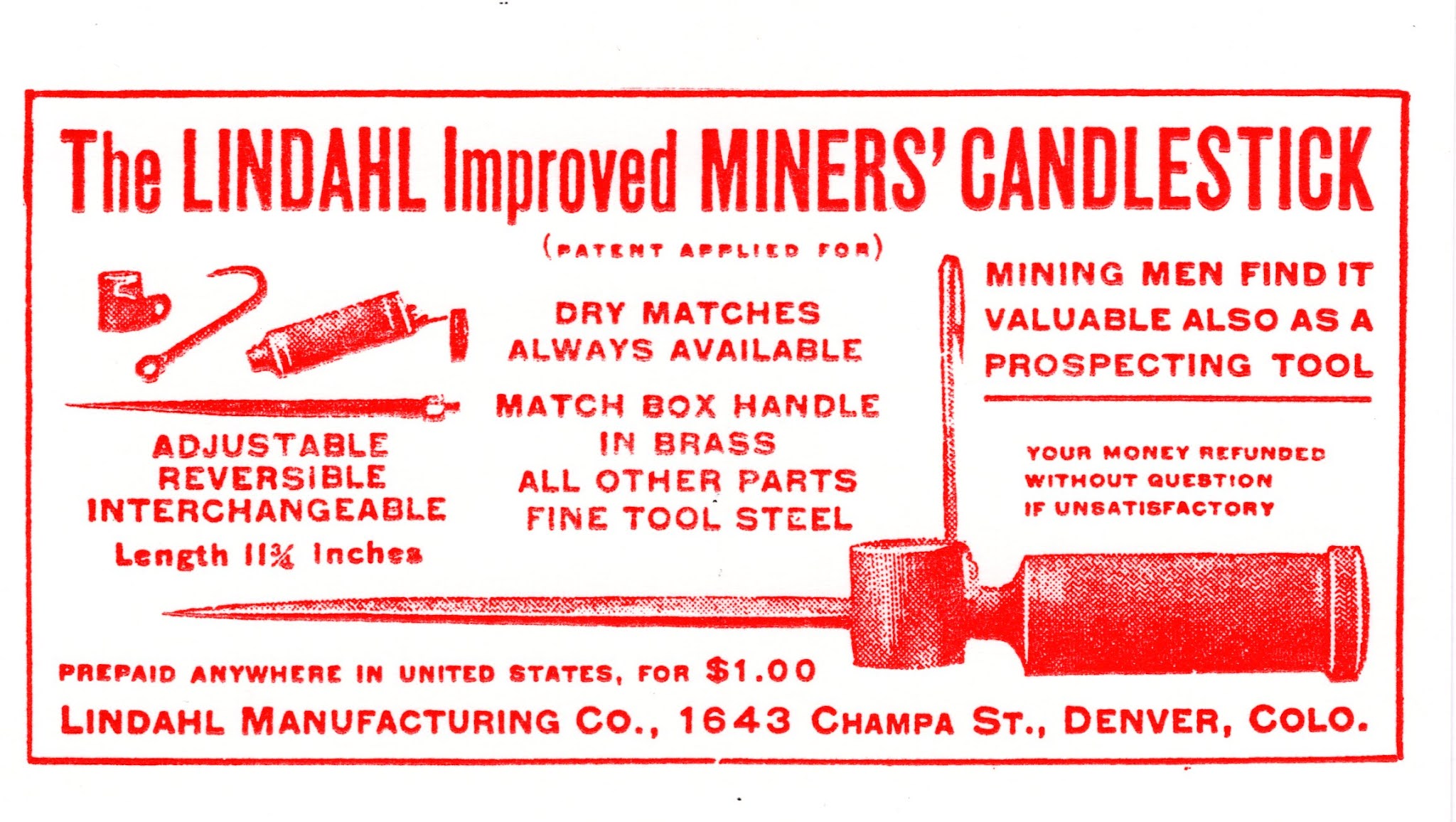
Figure 5. Advertisement for the Lindahl candlestick patented by John Lindahl in 1905. Lindahl lived in Colorado Springs. The candlestick was adjustable, reversible, interchangeable, and featured a case containing matches that replaced the loop handle in this model.
From the S.W. Veatch postcard collection.

        The two largest candlestick manufacturers were Nathan Varney of Denver and the Ludlow–Saylor Wire Company of St. Louis. A 1911 catalog advertised Varney candlesticks that cost six dollars per dozen (50 cents each). More elaborate candlesticks advertised in Mining Science in 1914 cost $1.50 each.

Candlesticks were simple, reliable, and easy to use. Cripple Creek miners used candlesticks for many years until carbide lamps and electric cap lamps made them obsolete in the early decades of the twentieth century. 

Miners found other uses for candlesticks. Crafty high graders used a hollow area in the curved handles of specially made or modified candlesticks to conceal high grade gold ore with candle wax or mud before they went home (Pohs, 1995).With their sharp, piercing points, candlesticks were used as weapons to settle arguments in the heat of the moment (Gosling,1969). In 1903, Colorado’s governor James H. Peabody escaped being killed by an assassin at a meeting he was scheduled to attend. The assassin intended to use the spike of a concealed candlestick as the murder weapon. The governor skipped the meeting and instead enjoyed a football game at the Colorado School of Mines (Pohs, 1995). 

Today, candlesticks can be found in private and museum collections. They are a symbol of the underground miner and the hard work he did. 

Acknowledgments

        I thank the Colorado Springs Oyster Club critique group for reviewing the manuscript, and Dr. Bob Carnein for his valuable comments and help in improving this paper. 

References and Further Reading:

Bartos, P., 2010, A light in the darkness: U.S. mine lamps, the early years—candlesticks, oil lamps, and safety lamps: Mining History Journal, vol. 17, p. 45-63.

Gosling, E. M.,1969, Miners’ Candlesticks: Spinning Wheel, vol. 25, Jan-Feb, p. 21.

Pohs, H. A., 1989, Early Underground Mine Lamps: Mine Lighting from Antiquity to Arizona: Museum Monograph No. 6, Tucson, Arizona Historical Society, p. 7-16.

Pohs, H. A., 1995, The Miner’s Flame Light Book: Denver, Flame Publishing Company, p. 121-214.

Ramsdell, J. and N. S. Wagner, 1982, Patents, Miners’ Candlesticks: Carson City, NV,  privately published.

Weicksel, S., n.d., Mining Charity, Retrieved from https://americanhistory.si.edu/fr/node/47976 on 5/18/2021.

Wilson, W. E. and T. Bobrink, 1984, A Collector’s Guide to Antique Miners’ Candlesticks: Tucson, The Mineralogical Record.