Showing posts with label Colorado History. Show all posts

Sunday, July 27, 2025

Secrets in the Shadows: A Mystery at Black Mountain, Colorado

1894 found Spencer Penrose and his partner Charles Tutt immersed in the Cripple Creek gold rush. They worked tirelessly to extract gold from their COD (Cash on Delivery) mine and broker real estate deals in the gold camp. Spencer’s brother, Professor Richard Penrose, a renowned expert in geology and mining, would occasionally visit the two partners in Cripple Creek, offering them valuable advice on the operation of their gold mine.  

Sometime in 1894, after a few too many drinks at Johnny Nolan’s saloon, the three men decided to escape from the town’s hustle and bustle and embark on a prospecting trip to the scenic Black Mountain area in Park County.  Leaving from Cripple Creek with minimal equipment, the trio planned to stay for a week. 

After riding about two days and covering 40 miles, they entered a canyon with blood-stained walls—scarred with the remnants of a gun battle, a chilling reminder of the bloodshed that occurred there years ago. The sounds of the wind whistling through the canyon seemed to echo the cries of the fallen warriors.  The canyon opened into the Black Mountain area, and seeing nothing there to warrant any prospecting, the three men rode on to look for a favorable spot for camping before nightfall claimed them. 

Stopping, around 5 p.m., they stood before a strikingly large and impressive house. It was a surprise for all of them. Its construction implied wealth and success. They stopped at the property’s entrance, where a broken gate and damaged fence hinted at neglect. As the three men looked around, they found the house’s front door and several windows open, with no signs of life. The sight of scattered debris and broken glass hinted at the possibility of a sinister event. The sound of the wind whispered through the towering pines, creating a haunting symphony that pierced the silence. The soft scent of damp earth and decaying aspen leaves mingled with what they saw and enveloped them in an atmosphere of mystery and intrigue. 

Image of what the abandoned house in the Black Mountain area of Colorado may have looked like when the Penrose brothers and Charles Tutt came upon it in 1894. Art by the author using AI.

The three men entered the house. One room opened to the right, its door slightly ajar, revealing a glimpse of what was inside. Another room opened to the left. A hall staircase separated the two rooms. Someone had evidently used the room to the right as a library or den. The silent rows of dusty bookshelves, holding a dozen forgotten books, looked like a tomb of lost stories. A mineral cabinet, holding some specimens, was built into the wall; someone had thrown other glittering mineral specimens onto the floor. A well-used riding crop, the leather polished smooth, hung beside a pair of elegant fencing foils and masks. This dusty room held the faint scent of leather and metal and echoed with the absence of laughter and life; only the rug on the floor hinted at past warmth. Then came a cold and unsettling surprise.

A chill snaked down their spines as they saw a woman’s long brown hair spread across the floor, its presence heavy with unspoken dread. Someone had squeezed the hair, hacking the ends off with a dull knife—the cuts jagged and rough—and then violently threw it. “Well, we had come there for mineral, not murder,” said Richard Penrose.  The entire scene was dreadful. 

As twilight descended, casting long shadows, the Penrose brothers and Tutt walked outside and saw kitchen utensils scattered across the ground. Peering into a barn they saw, that like the house, it was deserted. As it was getting late in the day, the trio decided not to investigate further, but rode on beyond this abandoned property into the open country a few miles away in order to select a spot to camp before night settled in.

At nine o’clock a loud snap of a twig sounded over the comforting crackle of the campfire, making everyone jump up from their blankets, where they’d been enjoying the fire’s warmth after their supper. A weathered prospector, his face tanned and lined, walked into the camp with a Winchester rifle slung across his shoulder. A burro, laden with supplies, followed close behind. “Hello partners; what luck?,” said the prospector. The conversation soon turned to the abandoned house. ‘Well boys, said the visitor, “I saw it go up. And the owner was always around. He was one of them English dude arrangements, wore an overgrown cap and yellow boots—kind of a sport. Never took no notice of nobody. Had one of them God Almighty airs with him.”   As recounted by the prospector, the Englishman spent money on the house and furnished it with items he hauled in from Balfour and Alma. The prospector claimed the English “dude” left for three months and then came back with a woman. “I’ve seen them many a time riding together, and damn me, I never saw such hair as that gal had. It was just about two years ago this spring, they both skipped God knows where. Some say they didn’t skip.”  According to the prospector’s account, another Englishman, an older man, showed up at the house. “That was the last of the young fellow and the girl with the fine locks.”  The prospector said that rumors suggested the old man was her husband, and she had run away with the younger Englishman. The old man—her husband—had followed and caught up with them at the Black Mountain property, after which the house was abandoned. 

The Penrose brothers and Tutt were lost in thought after the old prospector’s chilling tale. A hush fell over them as they listened to the whispers of the wind in the trees. The crackling fire cast an orange glow on the faces of the group as they sat around the campfire, pondering the old man’s tale. What happened to the woman? Why was her hair cut off? These questions lingered in their minds: why had the owners left the house and its sprawling grounds behind? The unanswered questions hung heavily in the chilly night air. The old prospector spent the night with the three men, saying he would not stay overnight at the Englishman’s house “for all the gold in Colorado; for the damn place is haunted.”

As dawn broke, the old prospector, armed with his Winchester, disappeared into the shadowy hills of the Black Mountain district with both his burro and his tales. The three men from Cripple Creek eagerly mounted their horses and left. The horses’ hooves resonated in the air, stirring up a cloud of golden dust that danced in the sunlight as they rode back to the gold-crazed Cripple Creek mining district, where ambition and the promise of riches fueled the energy of the town. 

In the years that followed, the Penrose brothers and Charles Tutt forged a path of tremendous success through minerals—copper and gold—and found their way into the history of the West and the American imagination. No one heard or wrote anything more about the mysterious woman and her lustrous locks. The old prospector slipped into oblivion.

Acknowledgments: I thank Bob Carnein for his insightful comments and help improving this manuscript.

References and Further Reading:

“Mystery of Colorado.” The Denver Press, September 7, 1894. p.6.

Veatch, S. W., 2017, The World’s Greatest Gold Camp: A Concise History of the Cripple Creek Mining District, in L.C. Kleinhans, et al., eds., Gold and Silver Deposits in Colorado Symposium: Golden, Colorado, Colorado School of Mines and others, p. 78-83.


Sunday, August 6, 2023

Bolts of Tragedy: A Teen's Fatal Encounter in the Cripple Creek Mining District

 By Steven Wade Veatch


            On a fateful Wednesday, July 15, 1914, 13-year-old John F. Bowen visited his friends at the Kilpatrick Ranch near Gillette, Colorado. It started out like any other day for John—his past behind him, his future ahead, but unlike other days, this would be his last day on Earth.

Young John Bowen had lived an eventful life. He was born in Leadville on January 12, 1901, to Irish parents. John and his family lived in the Big Stray Horse Gulch in Leadville. His father, Thomas, worked in a Leadville silver mine. Certainly, his father had heard about the roaring Cripple Creek Mining District while working in Leadville. Unable to resist the lure of the Cripple Creek goldfields, Thomas gathered up his family and moved to the “World’s Greatest Gold Camp.” By 1905, he was working as a miner at the Free Coinage Mine and lived in Altman, one of the mining camps in the district (Cripple Creek City Directory, 1905).

A mine headframe in the gold mining district.
The author created this AI image
with the assistance of DALL·E and MS Bing.

On that fateful Wednesday, John prepared to visit friends at the Kilpatrick Ranch, near Gillette, Colorado. When it was time to leave for Gillette, he no doubt kissed his mother, Mary, goodbye, waved to his siblings, and shook hands with his father, who was, by now, the town marshal. John quietly stepped through the door, went outside, and stood beside his donkey—ready to ride. He then hoisted himself onto the donkey's back, adjusted his grip on the reins, and gave a gentle kick. The donkey responded to John’s command, and with the donkey’s cautious step forward, they began their descent down a winding mountain road. He passed by several of the big gold producers (the Burns, Pharmacist, and Zenobia mines) in the Cripple Creek District.

Main Street (Baldwin Avenue) in Altman.
Photo date unknown. Courtesy of the Cripple Creek District Museum. 

Soon the mountain trail stretched out before them, snaking through lush greenery, wildflowers, aspens, and spruce trees. Sometimes long grass brushed against his trousers as he rode. His heart raced with excitement at the rhythmic sound of the donkey's hooves echoing through the crisp mountain air.

John’s hands gripped the reins firmly as the sure-footed donkey worked its way down the mountain with a steady gait. At times, the trail presented challenges—a steep incline, a narrow passage between rocks, and a bend in the road that made John lean into the curves, shifting his weight to aid the donkey's balance. Nature seemed to come alive around him. John noticed deer, hawks, and squirrels in the foliage, and each sight added to the thrill of the ride.

As they rode to Kilpatrick's Ranch, John felt the wind tousling his hair and smelled the scent of pine and earth in the air. Finally, the road brought him to a peaceful clearing—Kilpatrick’s Ranch—below Pikes Peak.

Perhaps his day can be thought of in this way: By the time he arrived at the ranch, the sun was high in the open sky as a group of teenage boys gathered at the corral. John dismounted and patted the donkey affectionately. The boys greeted one another with laughter and handshakes. The ranch, with its pastures, trails, ponds, and pine trees, promised endless possibilities. The boys reveled in the freedom that came with riding horses as they explored the sprawling landscape, galloped through open fields, and maneuvered around trees, rocks, and other obstacles.

As the afternoon ended, it was time for John and the donkey to head for home. John bade farewell to his friends, mounted his donkey, and started riding back home to Altman. He carried with him the memories of a day well spent on the ranch with his friends. The way back was uphill, and after a while, John dismounted and sat on a flat, lichen-encrusted stone to give his donkey a break. A storm seemed to be gathering.

As John and his donkey approached Altman (the camp with the highest elevation in the district) a storm developed. The sky roared with a primal fury as jagged bolts of lightning split the heavens and illuminated the darkness with their dazzling brilliance. Thunder reverberated through the air and a rumbling percussion shook the ground. Gusting winds whipped through the trees. The air crackled with raw energy, charging the atmosphere with electric tension. Nature's power was on full display, revealing unpredictable might.

Just as John and his donkey were nearing Altman, lightning stretched across the sky from hell to breakfast, and struck a nearby tree, causing it to explode. Newspaper accounts record what happened when he was close to home. The Rocky Mountain News published this incredible report on July 16, 1914:

He had visited the Kilpatrick ranch nearer Gillette and was returning to his home when he encountered an electrical storm. He had proceeded within a half mile of his home when a bolt of lightning struck a tree near the road. Rider and animal were felled by the effect of the bolt. Young Bowen was strapped securely in the saddle and when the burro arose later the limp form of the boy clung to the animal. The burro continued until he reached the yard of the Bowen home where the mother of the boy loosened him from the saddle and carried him into the house.

            Members of the Bowen family worked over the boy several minutes before he was revived. He became hysterical and asked strange questions. The family sought to calm him but failed.

            An hour after he had been brought into the house, young Bowen walked to a bureau, pulled out a gun, which was small caliber, and fired into his body above the heart, dying almost instantly.

            The shooting was witnessed by members of the family, but they were unable to reach the boy in time to prevent him from ending his life. The remains were turned over to the coroner (Youth Crazed by Lightning, 1914).

Lightning is a formidable force. It is possible that lightning struck John in this way: When lightning struck the tree, it jumped to John Bowen as well (Auerbach, 1980). John would have felt its impact through multiple systems of his body. Neurologic complications could have been severe, including loss of consciousness, confusion, memory issues, dizziness, headaches, seizures, and changes in sensation or movement. He would have suffered other problems, such as burns (from heat caused by the strike) and associated blunt trauma from explosive shock waves (Fontanarosa, 1993). Objects damaged or thrown by a lightning strike can cause physical injury. The only thing known for sure is that John was not the same after the lightning strike. His eyes finally opened, he gulped in some fresh air, got up, walked to a chest of drawers, opened a drawer, picked up a revolver, and shot himself.

John Bowen, a spirited teen boy, riding his donkey back to his home in Altman.
Rain started as the clouds grew darker. The author created this AI image
with the assistance of DALL·E and MS Bing.

John died at his home at the top of the hill. Time had slipped away from him, a life mostly unlived. The death of a teenage boy is a tragedy that makes us question our existence. It reminds us to appreciate the fragility of our time on Earth and appreciate the people around us.


John Bowen’s tombstone at the Sunnyside Cemetery,
Victor, Colorado.
Photo date 2023 by S. W. Veatch


References and further reading:

1905 Cripple Creek City Directory. Denver, CO: Gazette Publishing Company.

Auerbach, P. S., 1980, October. Lightning Strike. Topics in Emergency Medicine 2(3): p 129-136.

Fontanarosa, P. B., 1993, Electrical shock and lightning strike, Annals of Emergency Medicine, Vol. 22, Issue 2, Part 2.

Youth Crazed by Lightning, Sends Bullet into Body in Presence of Family., 1914, July 16. The Rocky Mountain News (daily), Vol. 55, No. 197.


Sunday, January 9, 2022

Beaver Brook Station

By Steven Wade Veatch A recently discovered historic photograph (figure 1) reveals a Colorado Central Railroad locomotive at Beaver Brook station, located in Clear Creek Canyon in Jefferson County, Colorado. Beaver Brook was one of several depots and water stops in the canyon on the narrow-gauge line that went from Golden to the goldfields of Central City and Blackhawk.
Figure 1. The Beaver Brook station on the Colorado Central Railroad. This station was frequently washed out by Clear Creek. Debris from flooding is evident in the photo. Locomotive number five (visible on the dome behind the smokestack) was built in 1873 by Porter-Bell. This number places the photo date before 1885, when number five was changed to number 31. Two men are taking a break at the front of the locomotive. Photographer and photo date unknown. Photo courtesy of the Cripple Creek District Museum.

A gold rush to the area started in 1859, following gold discoveries in the gravel of Clear Creek. George A. Jackson made a strike early that year near what would become Idaho Springs, where Chicago Creek joins Clear Creek (Ubbelohde, et al., 2015). A few months later, John H. Gregory panned $80 in nuggets out of gravels of the North Fork of Clear Creek not far from Jackson’s discovery (Abbot, et al., 1994). His location became known as Gregory Gulch. Prospectors and miners streamed into the area.
Soon Black Hawk, Central City, and Nevadaville were established (Ubbelohde, et al., 2015). These early discoveries launched the second largest gold excitement in the nation’s history. 

Prospectors, miners, and entrepreneurs developed access to the area. Edward Berthoud completed the Clear Creek Wagon Road by 1862. The Colorado Central Railroad followed in the 1870s and was extended through Clear Creek canyon in 1872 (Holden, 2016). The trip through the canyon was a wild ride. The train lurched and swayed as it slowly steamed along tracks above the creek. Its whistle pierced the air. Valve gears hissed, chuffed, and clanked. Wheels clacked on the rail joints in a rhythm that lulled the passengers into daydreams. When the train went around curves, the wheel flanges squealed and snapped riders out of their reverie. Cinders from the smokestack blew through open windows onto passengers who were packed into seats. The smells of coal smoke and lube oil from the locomotive filled the canyon. 
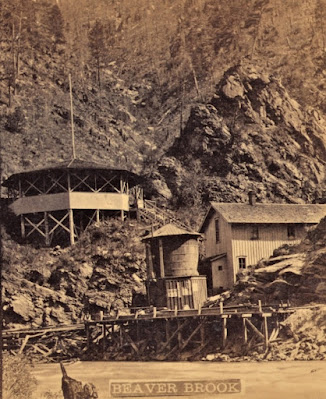
Figure 2. Photograph of the Beaver Brook station and water tank. A steep wooden staircase leads up to a picnic pavilion on the canyon wall next to the wooden station. Photo by Charles Weitfle; photo source: Library of Congress, reproduction Number LC-DIG-stereo-1s01668.
The Colorado Central Railroad also brought wide-eyed tourists who enjoyed waterfalls, wildlife, and cliffs as the train rolled through the scenic canyon. Beaver Brook station (shown in figure 2) was midway through the canyon and became a favored tourist stop (Abbott, et al., 2007). At Beaver Brook station, passengers marveled at the steep canyon walls, stretched their legs, enjoyed lunch, and accessed hiking trails (Holden, 2016). The railroad also built a picturesque pavilion perched on the slope above the station. Passengers spent time outside on the platform of the pavilion, where they ate picnics and enjoyed the views and the fresh mountain air.

Figure 3. A Colorado Central Railroad train has stopped on a bridge over Clear Creek at Beaver Brook station to take on water. People stand around the locomotive. Photo source: Wikimedia Commons, New York Public Library, MFY Dennis Coll 90-F28 Record ID: 730960.
This narrow-gauge line became part of the Colorado & Southern Railway and continued operations through Clear Creek Canyon until 1941, when the railroad became unprofitable and the rails were removed (Holden, 2016). Today, some say that if you listen carefully, you can still hear the whistle blow as the train winds its way through Clear Creek Canyon. 

Acknowledgments: The author thanks Pete Doolittle for improving this article. 

References and further reading:
 
Abbott, C., S. J. Leonard, and D. McComb, 1994, Colorado: A History of the Centennial State: Niwot, University Press of Colorado. 

Abbott, D., D.A McCoy, and R. W. McLeod, 2007, Colorado Central Railroad: Denver, Sundance Publishing. 

Holden, G. S., 2016, Clear Creek Canyon. Colorado Encyclopedia, retrieved from https://coloradoencyclopedia.org/article/clear-creek-canyon on June 6, 2021. 

Ubbelohde, C, M. Benson, and D. Smith, 2015, A History of Colorado: Portland, West Winds Press.

Monday, November 1, 2021

The Foster Ranch: An Early Colorado Springs Homestead

By Steven Wade Veatch   

            Marcus Aurelius Foster (1834-1923) made his way from New Ipswich, New Hampshire, to the Colorado Territory in its early days of settlement. He arrived in Colorado City, the first permanent town in the Pikes Peak region, in the spring of 1860 (Foster, 1964). Colorado Springs did not yet exist, and El Paso County would not be organized by the citizenry until 1861—one year after Foster’s arrival.

            The Pikes Peak region was a harsh and wild environment when Foster arrived. It was an expanse of shortgrass plains that ended where Pikes Peak and Cheyenne Mountain rose to the south and west. Dramatic red rock formations—the Garden of the Gods—in their skyward reach marked the transition of the plains to the mountains. At that time, the Utes traveled back and forth between their mountain hunting grounds to the west and the foothills to the east. In the winter, the Utes camped at lower elevations, sometimes near the Garden of the Gods or Manitou Springs.

Figure 1. A postcard showing the Garden of the Gods in the foreground and Pikes Peak in the background. From the S.W. Veatch collection.

            Foster’s arrival in the area marked him as one of the early El Paso County pioneers. He came along with other men who were determined to settle there. Few stores and fewer comforts were to be found. There were no railroads, and the only way to travel was on roads that were mostly tracks through grass-covered ground.

            Soon after Foster arrived in 1860, he rode up the Ute Pass trail to look around. He went as far as cone-shaped Mount Pisgah on the other side of Pikes Peak (gold would be discovered near there at Cripple Creek 30 years later). It was there that Foster met Ute Chief Ouray, who was watching a buffalo hunt from the top of Mount Pisgah. The men talked for a few minutes before Ouray raced down Pisgah’s steep slope to help his fellow hunters stop the buffalo from running away (Foster, 1964). After his encounter with Ouray, Foster rode back down Ute Pass to Colorado City.

            In 1861, Foster and J. B. Riggs left Colorado City for Buckskin Joe, a gold camp west of Fairplay. Foster and Riggs looked for gold as they shoveled gravel into a sluice box on Buckskin Creek (Foster, 1961). The record of Foster’s activities dims until four years later.

            Foster recognized the open, grass-covered landscape east of Ute Pass as an opportunity to claim and own land. He filed a homestead on 160 acres in South Cheyenne Cañon on December 1, 1865. The Civil War had ended eight months earlier, and Andrew Johnson was President. Few white people were in the area when Foster filed his homestead papers with the land office. Five years later, the census of 1870 recorded only 81 residents in Colorado City and 987 white people in all of El Paso County. General Palmer would not establish Colorado Springs until in 1871.

            Marcus Foster built a large ranching operation on his homestead that eventually included another 160 acres, for a total of 320 acres (Foster, 1967). His land and ranch house, right behind what is today the Broadmoor Hotel, was a busy place. He kept 35 “stands” of honeybees, had pigs and cattle, maintained large fields of hay and corn, kept a vegetable garden, and had a dairy operation (Foster, 1967).


Figure 2. Cheyenne Mountain looking south from the Foster ranch. Marcus A. Foster, and his son, stand by the wooden cellar ventilator. Modified from a cyanotype. Photographer and date unknown. Photo courtesy of the Cripple Creek District Museum. 

            Foster lived on his ranch with his wife Elizabeth and raised six children: Minnie, Helen, Marcus, Edith, Dora, and Lucy. Dora was born on the family homestead and became a well-known columnist for the Colorado Springs Gazette Telegraph. She was also the paper’s society and church editor. Besides her work at the Gazette, she wrote three books on Colorado history: Colorado Yesterdays, 1961; Then . . . The Best of Colorado Yesterdays, 1964; and My Childhood Days in Colorado Sunshine, 1967. She based her writing on her experiences and stories from residents of the early days of the region. Dora lived to be 94.

Figure 3. View of the Foster Ranch cattle pen. Mount Rosa and Stove Mountain are in the background. Modified from a cyanotype. Photographer and date unknown. Photo courtesy of the Cripple Creek District Museum. 
            In the spring of 1867, Chief Nevava, with his band of 500 Utes, left their winter encampment on the Arkansas River and set up a camp just below Foster’s ranch house. The Utes camped there for a brief period while they waited for the grass to green up and grow high enough for their ponies to eat before they continued on their travels.

            One day, the chief’s son, Nevava John, came to Foster’s house. Foster gave him coffee and other items. During the visit, Foster showed Nevava John a picture of William Henry Harrison’s Battle of Tippecanoe (1811) which included Indian warriors in an old Mitchell’s School Geography book in Foster’s library (Foster, 1964). This page, with the picture of the battle, interested Nevava John so much that he brought others from the camp to see it.

            Foster continued to maintain good relations with the local Indians. Old Chief Nevava, when he passed by Foster’s ranch, would occasionally stop and talk to Foster (Foster, 1964). Relations with the Indians were not always good, however. Dora wrote that one day in April 1867, a band of Ute Indians “were encamped on the banks of the Fountain, a short mile from my parents’ cabin. The Indians . . . were not known to be especially friendly toward the ranchers and were planning to drive them out of their prize hunting grounds here along the front range of the mountains “ (Foster, 1961).

            According to Dora Foster, the situation with the Indians deteriorated, and in 1868, the Indians struck at the settlers. She wrote, “People for miles around came and brought their families for protection from them, and we were forted up in the old Anway house located at 2812 W. Pikes Peak” (Foster, 1961). While the women and children stayed at the Anway house, the men, with rifles, stood guard on a nearby hill. Dora Foster continued writing about the attack:

We were living here when the three boys were killed by the Indians near where the Antlers Hotel now stands. They were herding cattle when they were attacked by the Indians from the hills. The oldest of the boys was young Everhart. He was 21 years old. The Robbins boys were younger. They were brought here and laid out in the old log building which was the first state house. It was located on the north side of Colorado Avenue, between 26th and 27th streets. I can just remember going with my sister to see the bodies, as everyone was flocking there so horrified and grieved over it. They were a terrible sight, scalped and speared, and they had placed their guns to their eyes and blew them out, and faces and necks all powder burnt. The Indians also stampeded stock (Foster, 1961).

            At Foster’s ranch, the days were long and the work hard. Cattle needed tending, the hay cut, and other crops cared for. Winters were cold and summers hot. Besides Indian troubles, grasshoppers infested the land periodically. In 1873, the area experienced a plague of grasshoppers. In response, Foster made a wooden frame with a long handle. At the opposite end of the handle he tacked a cloth sack on the wooden frame. Foster would then walk into his fields and swing the contraption back and forth at the horde of hoppers until he captured so many that the bag was full of grasshoppers. He would then take the buzzing bag near the pigpen, dump the insects into a pot of boiling water, and then feed the scalded hoppers to his pigs (Colorado Springs Free Press, 1951).

            In the summer of 1872, Marcus Foster, Daniel Kinsman, and Carter Harlan, all of whom had children of school age, organized a school board. Marcus Foster continued as a member of the school board for 32 years (Foster, 1964). Foster, a skilled carpenter, built the first schoolhouse with logs he hauled down from the east side of Cheyenne Mountain (Foster, 1961). The rustic school, built on Broadmoor Hill, had one room—about 12 by 14 feet—a door that faced east and four windows, two on each side of the school (Foster, 1961).

            In the fall, the school opened with Miss Mary Harlan as the first teacher (Foster, 1961). She was the twenty-one-year-old daughter of C.S. Harlan, the school board’s treasurer. There were eight pupils. Light came in from the windows and settled on the faces of the students as they sat at their desks. Each day, the older boys hauled a bucket of drinking water up from the creek and placed it on a wooden bench. A white metal dipper hung near the bucket.

            The school day was long, from 9 am to 4 pm with two fifteen-minute recess periods and an hour lunch. During recess and lunch, there were ball games and other activities outside (Foster, 1964). A huge pine tree grew in the schoolyard, and someone had attached a swing on a lower limb (Foster, 1964). The laughter of children filled the schoolyard during those recess periods. In the winter, there were indoor games. A round potbelly stove that burned coal heated the little log school.

            One day, a group of Indians rode into the schoolyard while the children were playing. The Indians were interested in the long hair of 10-year-old Anna Reihard and offered to trade some ponies for her. A scared Anna ran into the schoolhouse and shut the door. Fortunately, the trade was not made, and the Indians rode away (Foster, 1964).

            Sometimes during the noon recess, Frank Lewis, who lived just a short distance west of the schoolhouse, walked out on his porch, sat down on a wooden chair, and played his banjo. Hearing the music, the children walked a short distance with their lunch pails to his log cabin, where they listened to him play. When Lewis was not entertaining the students, he was building a mill on a nearby hill for Bert Myers, who had a 720-acre corn and wheat farm. After Myers finished the mill, he used the corn to make brooms that he sold in Colorado City. Meyer’s property later became part of the Broadmoor Hotel’s grounds.

            In 1881, Foster was elected to the Colorado legislature as a member of the House for two years. He served with Horace A. W. Tabor, who was a state senator and Lieutenant Governor. Frederic Pitkin was Governor.

            The Foster children entertained themselves in endless yet simple ways. In the spring, the scent of budding flowers and the smell of newly turned earth from Foster’s fields drifted in the air. This signaled it was time for the Foster children to pick wildflowers for their mother. To get to the wildflowers, they went behind the stables and crawled under a barbwire fence, and then walked down a path. To keep their dresses from tearing on the barbs, Foster wrapped the barbs with little pieces of cloth (Foster, 1961).

            There were many opportunities for fun. The Foster children put flat stones on the top of a big red anthill in the neighbor’s pasture, returning the next day to see if the ants had moved the stones. The ants always moved the stones several inches from the top of the anthill. They looked for wild bird nests and caught frogs along a water ditch. A special treat was a family trip to the Garden of the Gods for the day, and picnics among the towering red sedimentary rocks.

            On summer evenings, after supper was eaten and the dishes were cleared away, Foster and his wife sat on the front steps of the ranch house and watched their children play and gambol on the soft green grass. According to Dora Foster, the long winter evenings were the best part of each day, when the parents and children sat in the parlor room, lighted by a single kerosene lamp (Foster, 1961). It was in this room that the children read or worked on their homework. Sometimes Foster read stories to his children from the Toledo Blade that came once each week (Foster, 1961). He must have, on many occasions, pulled a book from the bookshelves to read to the children. His stiff fingers carefully turned the pages while the lamplight flickered against the uneven shadows.

            On winter evenings, after supper, Mrs. Foster brought a button box out and dumped its contents on the table. Dora wrote, it was “a box full of magic for my sisters and me when we were small” (Foster, 1967, p. 1). The Foster children, sitting around the table, played with the buttons, imagining the buttons were individual members of local families, and acting out endless stories.

Figure 4. A typical button box. Farmers and ranchers saved buttons for later use. Photo date 2021 by S. W. Veatch.
            The Foster ranch existed long ago, a place where a family experienced the pioneer days of Colorado Springs. In a newspaper article, Dora Forster wrote, “The soft mellow yellow light from the lamp, and the pleasant heat from the coal-burning stove seemed to me to be all that we wanted” (Colorado Springs Gazette Telegraph, 1972). Marcus Foster and his family lived in a timeless place of their own making. These historic photos resurrect those earlier days. Today, the frantic pace of modern life has replaced the much longer and simpler days experienced by the Fosters and other pioneer families.


Acknowledgments

            I thank Eric Swab and Dr. Bob Carnein for their valuable comments and help in improving this paper.


References and Further Reading

Colorado Springs Gazette Telegraph, 1972, Dora Foster Wrote about Pioneer Family: Colorado Springs Gazette Telegraph, March 23, 1972, p. 17BB.

Colorado Springs Free Press, 1951, Dorothy Smith Relates Stories of Early Days: Colorado Springs Free Press, October 17, 1951, p. 5.

Foster, Dora, 1961, Colorado Yesterdays: Colorado Springs, Dentan Printing Company.

Foster, Dora, 1964, Then . . . The Best of Pikes Peak Region Yesterdays: Colorado Springs, Dentan Printing Company.

Foster, Dora, 1967, My Childhood Days in Colorado Sunshine: Colorado Springs, Dentan-Berkeland Printing Company. 

Wednesday, October 6, 2021

A Cripple Creek Profile: Frank Finegan and His Requa Savage Mine

 By Steven W. Veatch

Francis “Frank” Finegan (1835-1914) was an adventurer who fought in the Civil War. And he was among the first group to arrive at the goldfields of the Cripple Creek mining district, where he located and patented several mines. Stockholders elected him president, treasurer, and general manager of the Requa Savage when he incorporated the mine on April 26, 1894 (Colorado State Mining Directory, 1898). 


Figure 1. The Requa Savage mine. A miner, named “Big Swede," stands by an ore cart under the headframe of the mine. Photographer and date unknown. Courtesy of the Cripple Creek District Museum. CCDM A 8315.

Finegan left enough of a record to trace his interesting journeys and see the stormy corners of his life. He was born in 1835 in Loughrea, County Galway, Ireland. In 1854, he sailed out of Liverpool to New York City (Portrait and Biographical Record of the State of Colorado, 1899). He then left New York City and lived for a time in Hartford, Connecticut, where he worked as a stonecutter and mason. He moved to California in 1857 and mined on the American River, the site of the original 1848 gold discovery in California. One year later, he sailed to Australia and farmed near Ballarat. With three partners, he located a gold mine near there. The partners worked it until 1859, when they sold their interests, each pocketing $35,000—a whopping $1,091,375 in 2020 dollars (Portrait and Biographical Record of the State of Colorado, 1899). 

Finegan left Australia and returned to California for a few months in 1860. He then moved to New York City. On April 12, 1861, at 4:30 am, while Finegan was fast asleep, Confederate General Beauregard ordered his gunners to open fire on Fort Sumter, South Carolina. Cannons roared like a crack of thunder. Explosions lit up the darkness and smoke settled over the fort. Thirty-four hours later, the besieged Union garrison raised a white flag and surrendered. The Confederates committed an act of war that forced President Abraham Lincoln to act. Two days later, Lincoln called for volunteers to fight in a war to preserve the Union. 

Finegan answered Lincoln’s call. He joined the 69th New York Regiment that month and was mustered into service for three months. The 69th Regiment was part of the Irish Brigade, which at the beginning included the 63rd, 69th, and the 88th New York Regiments and the 28th Massachusetts Regiment. The 116th Pennsylvania Regiment, made up of Irishmen from Philadelphia, was added during the fall of 1862 (R. Sauers, personal communication). The Irish Brigade quickly built a reputation for fierce fighting on the battlefield, and Finegan found a passage into hell when he fought in many of its engagements.

The 69th New York Regiment fought in the First Battle of Bull Run under the command of General William T. Sherman. During that battle, Confederate forces took Finegan prisoner. The Confederates released him on parole (Both sides had no means to take care of prisoners; Grant later stopped the practice of releasing prisoners). Once released, Finegan reenlisted for three years and returned to the battlefield. 

Finegan saw combat at the Battle of Fair Oaks (Henrico County, Virginia) on May 31 and June 1, 1862. It was there that he saw the use of Union balloons, some reaching altitudes of over 1,000 feet, to report enemy positions and direct artillery fire. 

Later, at the Cornfield Battle of Antietam (September 17, 1862), Finegan went down hard with a savage head wound while carrying the flag (Portrait and Biographical Record of the State of Colorado, 1899). Almost 8,000 Union and Confederate soldiers were killed or wounded in the Cornfield Battle. 

Finegan fought in the Battle of Gettysburg (July 1 - 3, 1863), where he witnessed horrific sights. He surely would have heard flags flap in the wind and bullets whizz by. The air was heavy with the scent of blood. There were fields of slaughtered and decaying bodies everywhere. While marching down a road jammed with troops and shining bayonets, he doubtless heard the cries of the wounded and the amputees, and then noticed a heap of amputated legs, feet, arms, and hands under a tree. During the Civil War, doctors performed a lot of amputations to prevent wounds from becoming infected. Antibiotics used to kill germs had not been invented yet. Gettysburg was the bloodiest clash of the Civil War and came with a high casualty list for both sides: 7,058 died; 33,264 wounded, and 10,790 went missing (LeBoutillier, 2017). As the war continued to intrude into his life, Finegan was becoming a hardened fighter who learned his skill on the battlefield.

Finegan, who was likely detached from the 69th Regiment, took part in the siege of Vicksburg (May 18 – July 4, 1863) as Grant directed artillery fire at the city. The air burst into flames as the shelling continued, and then Grant’s army relentlessly attacked the city for over 40 days. Eventually, the food and supplies ran out, forcing the soldiers and citizens of Vicksburg to eat mules and rats (Stanchak, 2011). The Confederate forces at Vicksburg surrendered on July 4, 1863. Amid the broken bricks and fires, a few homebound citizens must have watched through shattered windows as the Union forces marched by.

Finally, Finegan survived two later battles: the Battle of the Wilderness (May 5 - 7, 1864), in Spotsylvania County, Virginia, and the Spotsylvania Court House Battle (May 8 - 21, 1864). 

Finnegan was among many who witnessed the great suffering, horror, madness, and destruction of the Civil War that resulted in a horrific cost of life in the nation’s bloodiest war—at least 750,000 soldiers died, hundreds of thousands of others were wounded in battle, and an unknown number of civilians perished (McPherson, 2015). An estimated two percent of the population was killed (Ward, 1990). The Civil War set four million slaves free, brought the downfall of the Southern planter aristocracy, and preserved the Union as one nation, indivisible. 

Figure 2. Battle of Gettysburg. Painting by Thure de Thulstrup. Original scan: Library of Congress. Public Domain.

Having miraculously survived these bloodbaths, Finegan returned to New York City, where he mustered out in June, 1865. After he left the Army, Finegan returned to Australia once again. He settled in Victoria, where he worked in contracting and building. Then, in 1874, he moved to San Francisco where he worked as a stonecutter and mason. In 1880, he moved once again, this time to Colorado Springs, Colorado. He started a building business and lived at 225 S. Cascade. In 1881, he was elected alderman and served six years on the city council of Colorado Springs (Portrait and Biographical Record of the State of Colorado, 1899). 

In the shadow of Pikes Peak, peripatetic Finegan was becoming restless; excitement was absent in his life. This was about to change in 1891, when gold fever from the Cripple Creek mining district infected Finegan. The only cure for him was to come to the district and step into mining. About the time Finegan arrived in the district, a prospector, with the swing of his pick, revealed a streak of bright gold ore at a spot on the side of Beacon Hill. This discovery set in motion the establishment of the Requa Savage mine, in which Finegan was the driving force. Finegan incorporated the Requa Savage so optimists could invest in the mine. Now there were funds to hire engineers and miners and to buy machinery to develop it. 

Some maintain that Finegan named the mine after “Uncle” Benjamin Requa, an early settler, or for the nearby Requa Gulch. The gold mine was near Arequa, one of the oldest towns in the district. By 1896, the town of Arequa, named after Ben Requa, included the “A” as the first letter of its name, as seen in the map in figure 3 (Mackell-Collins, 2014). The Requa Savage was on the north side of the Gold Dollar mine (see map figure 3).

Figure 3. Map of the Cripple Creek Mining District, 1896. A red arrow points out the Gold Dollar mine. The Requa Savage mine is just north of the Gold Dollar. The town of Arequa is underlined in red. Map source: Hoyer-Millar (1896).


Figure 4. View of Beacon Hill. A red arrow shows the location of Arequa. Photographer unknown, date mid-1890s. From the Olla Burris collection, Cripple Creek District Museum. 

As time passed, the Requa Savage became known as a modest producer. According to the Mining and Engineering Journal (1910), the Requa Savage mine, in 1910, shipped two carloads of ore assaying at one ounce per ton. Other carloads yielded less gold, but the mine produced $100,000 that same year. 

The passage of time would not be kind to Frank Finegan. He fought cancer but lost that battle and died on October 22, 1914, in Colorado Springs, at 79. His family buried him in the Evergreen Cemetery. 

Figure 5. View of the Requa Savage mine. Ten miners pose in front of the mine. Photographer and date unknown. Courtesy of the Cripple Creek District Museum. 

History records that, over time, Finegan was one of several prominent men associated with the Requa Savage mine. Records show that by 1912, the One Hundred and One Mining Company owned the mine (Mining Science, 1912). In 1913 The Mining Investor reported that Democratic Colorado State Senator Louis A. Van Tilborg (1870-1937) worked the Requa Savage mine for a short time. Van Tilborg, a druggist and an assayer, was the mayor of Cripple Creek from 1907 until 1911. He served in the Colorado legislature from 1911 to 1914. The presence of gas forced Van Tilborg to suspend work at the mine. Once the mine resolved the gas issues, production resumed under the lease of Kermit MacDermid, of the C.K. and N. Mining Company (The Mining Investor, 1913). By this time, the Requa Savage’s surface plant included a shaft house equipped with a steam hoist and electric compressor. 

Although the Requa savage mine claimed a small area of land, it boasted five shafts. By 1914, the main shaft reached 700 feet deep (Consolidated Extension Mines Company, 1914). A crew of miners disappeared down the main shaft at the start of each shift and then drilled, blasted, and mucked in the shadows of the mine as they followed the occasional blossom of gold ore in barren rock. By 1914, the Requa Savage was owned by Rainbow Gold Mines Company. Rainbow Gold then leased it to another operator who, based on reports of good gold ore, planned to expand the development of the mine (Consolidated Extension Mines Company, 1914). 

A new group of investors reincorporated the Requa Savage Gold Mining Company in November, 1915, as the Requa-Savage Mines Company with offices at 112 N. Tejon Street in Colorado Springs (Weed, 1918). A report showed the mine was producing ore in 1929 (Kiessling, 1929).

According to The Mining Journal (1935), Commonwealth Gold leased the Requa Savage mine. Mr. Wellington Symes, who was the president and general manager of the property, subleased it to a group in Denver; and Andy Vidgen, the mine superintendent, purchased new machinery to increase ore production (The Mining Journal, 1935). 

As the years passed by, the ore decreased until the mine became unprofitable. The owners then closed the mine. Today, as you drive on Highway 67 between Cripple Creek and Victor, you will pass where the town of Arequa and the Requa Savage mine were once located. Both places now exist only in the pages of history. And we are reminded of Frank Finegan and how he emerged from obscurity and left his mark on time through his Civil War exploits and his ownership of a Cripple Creek mine. 


Acknowledgments

I thank the Colorado Springs Oyster Club critique group for reviewing the manuscript, and Dr. Bob Carnein for his valuable comments and help in improving this paper. 


References and further reading:

Colorado State Mining Directory, 1898: Denver, Western Mining Directory Company.

Consolidated Extension Mines Company, 1914, Referring to the Requa Savage mine on Beacon Hill in the Cripple Creek District, owned outright by Rainbow Gold Mines Company. United States Bureau of Mines: Colorado School of Mines Library Digital Collections, retrieved from https://mountainscholar.org/handle/11124/171813 on June 5, 2021. 

Hoyer-Millar, C. C., 1896, The Cripple Creek Gold-Fields, Colorado, U.S.A: London, Eden Fisher & Co. 

Kiessling, O.W., 1929, Mineral Resources of the US 1929: Washington DC, Dept of Commerce.

LeBoutillier, L., 2017, Secrets of the U.S. Civil War: North Mankato, MN, Capstone Press.

MacKell-Collins, J, 2014, Arequa Gulch: A Long Gone Town in Colorado, retrieved from https://janmackellcollins.wordpress.com/2014/03/20/arequa-gulch-a-long-gone-town-in-colorado/ on January 10, 2021.

McPherson, J., 2015, The War that Forged a Nation: Why the Civil War Still Matters: New York, Oxford University Press. 

Mining Science, 1912, Denver, vol 65, no 1,682, April 18, 1912.

Portrait and Biographical Record of the State of Colorado, Part 2, 1899: Chicago, Chapman Publishing Company.

Stanchack, J., 2011, Eyewitness: Civil War: New York, DK Publishing.

The Mining Investor, 1913: Denver: The Mining Investor Publishing Co, no 1, vol 71, May 19, 1913.

The Mining Engineering Journal, 1910, New York, Hill Publishing Company, vol 89, Jan-June 1910.

The Mining Journal, 1935, February 28, 1935, pg. 18, retrieved from https://vredenburgh.org/mining_history/pdf/AMJ-1935.pdf on February 15, 2021. 

Ward, G.C., 1990, The Civil War: An Illustrated History: New York, Alfred A. Knopf.

Weed, W. H., 1918, The Mines Handbook: New York, W. H. Weed Publishing.


Friday, May 21, 2021

The Lennox House: A Mansion Built from Cripple Creek Gold

 By Steven Wade Veatch

William Lennox (1850-1936), after prospecting in the mountains near Fairplay, Colorado, headed down to Colorado Springs, a new town at the foot of Pikes Peak. He established himself as a businessperson and later invested in Cripple Creek mines. These mining investments made him a millionaire almost overnight. 

The now wealthy Lennox built a new home, one that would show his position in Colorado Springs’ society. He hired the well-known Denver architect Frederick J. Sterner to design his two-and-a-half story mansion across from Colorado College—at the northeast corner of North Nevada Avenue and Yampa Street. Lennox started his home building project in 1900 (at a cost of $50,000) and moved into his stylish home in May 1901 (Lennox, 1901). Lennox hired James H. Barry as the general contractor for the construction of his home (National Register of Historic Places, 1999).

Photo of the Lennox House, 1001 N. Nevada Avenue, Colorado Springs, Colorado. This cyanotype  was taken around 1901 (courtesy of the Cripple Creek District Museum). This was written in pencil on the back of the cyanotype: "Lennox's new house NE corner Yampa and Nevada.” 

Repeat photo of the Lennox House taken February 2021 by S. W. Veatch. 

The Lennox house was one of Sterner's first commissions in Colorado Springs, and soon his architectural designs were in high demand among the city's leading citizens. Sterner’s local projects included General William Jackson Palmer's (the founder of Colorado Springs) second Antlers Hotel and the renovation of Palmer’s residence, Glen Eyrie, both in 1901 (Lennox Walking Tour). 

The Lennox house featured elements of the Mission Revival style in an interesting display of large curvilinear parapets, smooth stucco walls, quatrefoil windows (an ornamental design of four lobes resembling a flower), arched windows, and porches with arcades. A stunning red tile roof topped the structure (Central Downtown Historic Walking Tour). 

Lennox finished the interior of the home with hardwood, an open design, lots of windows, and large doorways. Several large eye-catching fireplaces heated the home.

Perhaps on a warm summer afternoon, after years of visible success, Lennox walked down a path, fringed with blue flowers, to a bench between two cottonwood trees and sat down. A songbird chirped on a fence post. As calm as a stone in a pool of deep water, he looked at Pikes Peak and thought about his life, how it began, and how it had changed. 

Lennox, the child of Scottish immigrants, was born on Christmas Day in 1850 in Iowa. Looking back on his life in 1901, Lennox wrote, “I was brought up on my parent's farm and used to hard work . . . I attended the Iowa State University at Iowa City. I could not spare time from farm work to graduate but acquired sufficient learning to teach a country school” (Lennox,  1901).

With his parents and siblings, Lennox made the journey from Iowa to Denver on the Kansas Pacific Railroad, and from there they traveled by stage on a rutted, dusty dirt road to Colorado Springs. They arrived in April 1872. According to Lennox, his parents “bought and moved to a ranch at Edgerton, on the west side of Monument Creek, about ten miles north of Colorado Springs” (Lennox, 1901). Just nine months earlier, on July 31, 1871, General William Jackson Palmer, a Civil War veteran and railroad tycoon, had established Colorado Springs. Promoters called it the Fountain Colony, and Colorado was still a territory. 

The same month they arrived in town, Lennox and his brother helped plant the first cottonwood trees General Palmer brought in to shade the wide streets of the business center of the city (Lennox, 1901). The trees gave the city a burst of green when it had been a treeless prairie.

The 22-year-old Lennox pondered infinite possibilities. He had both the appetite to succeed and the will to make it happen. He was a westward-looking man, and Fairplay was not too distant for hope. Lennox left Colorado Springs for a few months to prospect and mine near Fairplay. He then returned to Colorado Springs in 1873 and started a feed and livery business at the age of 23 (Lennox, 1901). The following year he added the handling of coal as the agent for the Denver & Rio Grande Railroad, and later a freight-transfer business entered his orbit of business enterprises (Lennox, 1901).

In 1876, Lennox married Belle Cowgill. He went to Iowa for the ceremony and returned to Colorado Springs with his bride. They had six children; two died in childhood. 

Lennox emerged as the largest coal dealer in the Pikes Peak region. He continued in the coal and transfer business until April 1901 (Lennox, 1901). 

While operating his coal yard, Lennox invested in mining operations in Gunnison, Summit, and Teller counties (National Historic Register of Historic Places, 1999). In 1891, Lennox bought Robert Womack’s El Paso lode (Portrait and Biographical Record, 1899). Womack was the first to find gold at Cripple Creek, in 1890, and his El Paso strike started a gold rush to the area. Lennox next organized the Gold King Mining Company, which included the El Paso lode. Lennox invested in other Cripple Creek mines. Along with Ed Giddings, who owned a department store in Colorado Springs, and Judge Colburn, Lennox leased the Strong mine in Victor (Sprague, 1953). One report states that the Strong lease brought $20,000,000 to the Lennox group (Newton, 1928). Lennox also became a major shareholder and officer of the Ajax mine, also in Victor (Wilkins, 1983).

The Gold King mine. Womack's claim came under the ownership of the Gold King Mining Company. Undated photo by A. J. Harlan. Courtesy of the Cripple Creek District Museum. CCDM A84-30.

Lennox became a millionaire as the Cripple Creek mining district became the foremost producer of gold in the nation (National Register of Historic Places, 1999). Luck had been Lennox’s constant companion.

While banking his Cripple Creek fortune, Lennox served as president of the Exchange National Bank in Colorado Springs. Furthermore, he served as vice-president and director of the Colorado Springs & Cripple Creek District Railway—the third railroad into the gold camp (Wilkins, 1983). He also owned large cattle ranches in Texas. 

This vintage color postcard depicts the Colorado Springs & Cripple Creek Railway (also known as the Short Line) at St. Peter’s Dome. This line provided one of the most scenic train rides in the state. William Lennox invested in this railroad and served as vice-president and director of the line. From the S.W. Veatch postcard collection. 

In 1902, Lennox built the Lennox Hotel at 226-228 N. Tejon Street with furnished rooms on the upper floors that served middle-class tourists and railroad workers. The ground floor was a storefront for the Knight-Campbell Music Company.

Lennox Hotel circa 1903. There is a sign "Lennox" over the second floor windows and hotel doorway. The Knight-Campbell Music Co. occupies the storefront on the left side of the building. Note the wide street with streetcar tracks. Photographer unknown. Courtesy of Special Collections, Pikes Peak Library District, 001-5622.

        By 1921, the Lennox changed its name to the Albany Hotel. The Albany sent cars to the railroad depots to pick up passengers who were staying at the hotel. The hotel offered a guide and touring cars for the “Four Hour Circle Trip” that included Garden of the Gods, the Cliff Dwellings, Cave of the Winds, Ute Pass Canyon, Manitou and the local mineral springs, and the foothills of Pikes Peak (Albany Hotel Brochure, 1921). The hotel offered longer excursions that took guests up Pikes Peak, to Cripple Creek, and to the Royal Gorge. These scenic auto trips, operated by the Colorado Touring Company for the hotel, left directly from the Albany and returned passengers to the hotel at the end of the trip.

Room rates in 1921 started at $3.00 (about $44 in today’s dollars) for two people (Albany Hotel Brochure, 1921). Today the Albany Hotel provides apartment units with the ground floor divided into a lobby and a separate retail storefront. 


Interior of an Albany Hotel guest room circa 1921.
Photo from a brochure promoting the hotel.
From the S. W. Veatch collection. 


View of the Albany Hotel, originally the Lennox Hotel. Architect Thomas MacLaren designed the three-story commercial brick  building at 228 N. Tejon for William Lennox as a variation of the Classical Revival style. Photo date March 2021 by S. W. Veatch.

Lennox, concerned with the progress of the community, always looked ahead for the development of Colorado Springs. And, as a member of the Chamber of Commerce, he worked tirelessly to promote the city. He was deeply interested in education, and from the year he moved into his mansion (1901), he served on the Colorado College Board of Trustees until his death on August 13, 1936, at 85. 

In his will, Lennox left his house to Colorado College. After receiving Lennox's home from his estate in 1936, the college engaged local architect Edward L. Bunts to design plans to remodel the home as a student center. The college spent $40,000 renovating the property for use as a multi-purpose student center that functioned as a place for student dining, recreation, the student government offices, the college newspaper, and social gatherings from 1937 to 1959. A few years after it opened as a student center, the college bookstore used the second floor. Henry E. Mathias, the former head of the Geology Department, acted as the center's director. 

In 1959, the newly constructed Rastall Center opened as the new student center. The Lennox house, after another remodel, became home to the Beta Theta Pi fraternity for 30 years. The college conducted an intensive German language program there in the summers. 

In 1989, the college renovated the building for use as a coed dormitory. The college listed the Lennox house on the National Register of Historic Places in 1999. Today, Lennox’s home is known as the Glass House, a co-ed residence for 20 students to explore and expand multicultural awareness. 

The Lennox House is an important landmark in Colorado Springs for its architecture and history. The building, built with money from Cripple Creek gold, shows the association of William Lennox, a Colorado Springs pioneer and a wealthy Cripple Creek mining investor, and the college that he financially supported. And the Lennox house still stands, just like Pikes Peak—defiant against time.

Acknowledgments

I thank Shelly Veatch and the Colorado Springs Oyster Club critique group for reviewing the manuscript, and Dr. Bob Carnein for his valuable comments and important help in improving this paper. 

References and Further Reading:

Albany Hotel Brochure, 1921, Advertising brochure promoting the hotel and Colorado Springs.

Central Downtown Historic Walking Tour, Colorado Springs, 2004: retrieved from https://coloradosprings.gov/sites/default/files/planning/cenwalkingtour.pdf, on March 15, 2021.

Lennox House, History Walking Tour, Colorado College: retrieved from https://www.coloradocollege.edu/basics/campus/tour/historic/lennox.html, on February 9, 2021.

Lennox, W., 1901, Century Chest Collection, 1901. Letter written August 4, 1901 to My Great Grand Children, Colorado Springs: retrieved from https://digitalccbeta.coloradocollege.edu/pid/coccc:10790, on February 9, 2021. Note: This letter, written by William Lennox, is from a time capsule, the “Colorado Springs Century Chest Collection, 1901. It was stored for 100 years in various locations on the Colorado College campus. On January 1, 2001, the chest was opened at the Tutt Library of Colorado College. The college scanned items from the chest and transcribed many of the letters.

National Register of Historic Places, 1999, Registration form: Lennox House, Colorado Springs, El Paso County, Colorado, National Register #99001266 United States Department of the Interior, National Park Service.

Newton, H. J., 1928, Yellow Gold of Cripple Creek: Anecdotes and Romances of the Mines, Mining Men, and Mining Fortunes: Denver, Nelson Publishing Company.

Portrait and Biographical Record of the State of Colorado: Containing Portraits and Biographies of Many Well Known Citizens of the Past and Present, 1899: Chicago, Chapman Publishing Company.

Sprague, M., 1953, Money Mountain: The Story of Cripple Creek Gold: Lincoln, University of Nebraska Press.

Wilkins, T. E., 1983, Short Line to Cripple Creek: The Story of the Colorado Springs & Cripple Creek District Railway: Golden, The Colorado Railroad Museum, Colorado Rail Annual Number 16. 


Tuesday, February 16, 2021

The Captive Pony

 By Steven Wade Veatch

With the turning of each page in the frayed leather album, the old blue photographs or cyanotypes, possibly over 12 decades old, conjured the past and a way of life that is gone.  One group of photographs reveals part of one day on a ranch, about 20 miles east of Colorado Springs, in eastern El Paso County, Colorado. This might be the story of these blue images. 

The riders had an early start. The night chill faded as the sun climbed in the sky. A cowboy, sitting low in his saddle, looked out across the endless reach of the high plains that spread out in all directions. He spotted a wild pony. 

Cowboys approaching a wild pony. Written in pencil on the front of the cyanotype is: “Catching a wild pony, Russell’s ranch.” Unknown photographer. Undated cyanotype. From an album of an unidentified owner. Courtesy of the Cripple Creek District Museum.

Turning back in his saddle to call the others to help him catch the pony, he could see Pikes Peak mantled with snow. This group of young men, who appeared older because of the hard work they endured, slowly rode toward the wild pony. 

When the cowboys reached the pony, they pulled their horses to a stop. The wild pony nosed the ground as it grazed on grass. Stems of dead grass stuck to its mane. Flies buzzed around. The air smelled fresh. 

One cowboy rode quietly forward, stopped, and lassoed the pony while the others watched. This outfit of saddle-sore cowboys, tough as leather, headed back to the ranch with the pony in tow. The sun was now high in the sky and the day inched along as they rode back. Along the way meadowlarks sang, grasshoppers jumped, and butterflies flew around the wildflowers. Prairie dogs stood straight as sentries, peeked at the riders, and then dived into their holes. A soft breeze blew out of the west, rustling the tumbleweeds.

When they arrived at the ranch, a wrangler led the wild pony inside the corral. A ranch hand threw a log on the fire in the middle of the corral. Smoke drifted toward the gate. A branding iron, sitting in the hot coals, glowed a bright red on its business end. Several of the men brought the pony to the ground, tied its legs together, and then a wrangler branded it, marking ownership. Tomorrow the cowboys would break the wild pony.

Branding the wild pony back at the ranch. There is a lot going on in this cyanotype. The shadow of the photographer is in the lower left. In the background, behind the gate, is a woman looking out wearing a bonnet and a prairie dress. Written in pencil on the front of the cyanotype: “Branding same pony, Russell’s Ranch.” Unknown photographer. Undated cyanotype. From an album of an unidentified owner. Courtesy of the Cripple Creek District Museum. 


Cattle, lowing and bawling, stand in a stock pond to cool off. Written in pencil on the front of the cyanotype: "Russell’s Ranch 20 miles east of Colorado Springs." Unknown photographer. Undated cyanotype. From an album of an unidentified owner. Courtesy of the Cripple Creek District Museum.


Three men and a woman pose on the porch of a mudbrick house on the ranch. A cat rests on the steps. Five large pumpkins sit on the porch. Barnyard chickens peck on the ground in the far right of the photo. Written in pencil on the front of the cyanotype: “Doyle’s House, Russell’s ranch.” Unknown photographer. Undated cyanotype. From an album of an unidentified owner. Courtesy of the Cripple Creek District Museum.

        After the branding and the completion of their tasks, some cowboys sat on the front porch of one of the ranch houses and relaxed after a hard day of work. They peered out from the shadow of the porch and thought about all the newcomers moving into the area, crowding the land. Each one wondered how soon their way of life would be corralled and changed like the wild pony they branded. 
__________________________________
Note: The cyanotype process uses light sensitive iron salts instead of silver salts on paper. This simple and low-cost process made prints in blue used for making proofs instead of finished prints and was popular with some amateur photographers. Dates in popular use: 1880-1910.