By Steven Wade Veatch
Miners in the Cripple Creek mining district once drilled, blasted, and mucked deep underground by the light of a candle. Not only did these candles illuminate their work areas, but they also provided shadows for Tommyknockers to hide in.
In Cripple Creek, as in other mining districts, mine owners supplied miners with candles; however, they required miners to buy the holders for the candles. Miners called these holders “candlesticks.” Most candlesticks were mass-produced and sold through mining supply stores and catalogs—even Sears and Roebuck sold miners’ candlesticks. These generally had similar designs, but there were a large number of patented variations.
To make it easier for miners to replace damaged or worn out candlesticks, a purveyor of these basic devices visited Cripple Creek and other mining towns and peddled them directly to the miners. In figure 1, a man is selling candlesticks to a group of miners. He used two burros to pack the miners’ candlesticks from town to town.
 |
| Figure 1. A man, next to the donkey in the right side of the photo, is selling candlesticks to miners at a mine in the Cripple Creek mining district. Candlesticks are piled on the back of one burro (right side of photo) for display. A group of miners, some carrying lunch pails, gather around him. The photo, by an unknown photographer, is dated November 12, 1897. From the Olla D. Burris collection. Photo courtesy of the Cripple Creek District Museum. |
An entire industry developed producing mining candles made from stearic acid and paraffin wax. The stearic candles used in Cripple Creek had many benefits: They emitted little smoke and were suited for some of the poor ventilation found in underground mining. These candles gave a steady source of light and were not easily blown out in a draft. Candles were easy to handle and simpler to transport than oil lamps. Mine owners viewed candles as less of a fire risk than oil lamps. A miner could easily put out a candle that tumbled over before it set mine timbers on fire. If a miner knocked over an oil lamp its destructive flames spread rapidly.
Candle manufacturers set the standard diameter of candles at 0.75 inches. Candle lengths varied, but averaged about 9 inches (Bartos, 2010). Manufacturers wrapped candles in sets of six and packed them into boxes of 120 or 240 candles. The cost of a 240-unit box was between $3 and $5 (Bartos, 2010). Miners burned through three or four candles per day (Bartos, 2010).
 |
| Figure 2. Miners with burning candles in their candlesticks take a short break while in a stope in the Half Moon mine. Unknown photographer and date. From the Olla D. Burris collection. Photo courtesy of the Cripple Creek District Museum. |
Candlesticks used in metal mining began to appear in California in 1860 and were used in mines throughout the American West (Bartos, 2010). The traditional miners’ candlestick was simply an iron spike, about one-quarter inch in diameter, averaging 12 inches in length. Miners hammered the iron spike on candlesticks into a mine timber or a fracture in a rock surface (Weicksel, n.d.). A miner with a burning candle in a candlestick could put it close to where he needed light to work. At the end opposite of the candlestick’s point is a loop that acts as a handle (see figure 3). A circular holder (thimble) near the handle or center of the spike holds the candle perpendicular to the spike. Next to the candleholder is a hook to hang the candlestick on rocks when the miner could not find any mine timbers or rock cracks to drive the spike into. It was also used to attach the candle to his cap.
 |
| Figure 3. Diagram of a typical miner’s candlestick. Source: Wilson and Bobrink, 1982. |
Candlesticks came in many varieties and sizes: Some were handmade by a local blacksmith, homemade by a miner, manufactured, unpatented or patented (table 1 shows candlestick patents held by Pikes Peak area inventors). Some candlesticks folded up around a central pivot point, allowing a miner to slip it into his pocket as he walked into the mine (Pohs, 1989). Others were simple in their design (see figure 4).
 |
Figure 4. The March 1899 patent design for William Pleasants’ candlestick.
Pleasants was a resident of Víctor. Source: Ramsdell and Wagner, 1982. |
|
Table
1.
Miner's Candlesticks Patents
As
applied for by residents of the Cripple Creek Mining District, Colorado
Springs, and Colorado City, Colorado.
|
|
Applicant
|
Residence
|
Date
|
Patent No.
|
|
William
Lincicum and Charles F. Lewis
|
Colorado City
|
Nov. 1895
|
549,925
|
|
William
H. Pleasants*
|
Victor
|
Mar. 1899
|
D-30,406
|
|
William H. Pleasants
|
Victor
|
June,1899
|
D-30,991
|
|
Amede Bernier
|
Victor
|
Aug. 1899
|
631,270
|
|
Christopher Peacock*
|
Altman
|
Aug. 1900
|
656,209
|
|
Charles
Cornell and Felix John Troughton
|
Victor
|
Jan. 1901
|
665,067
|
|
John B. Lindahl*
|
Colorado Springs
|
Oct. 1905
|
801,465
|
|
Harry
D. Pelham and Charles P. Kaba*
|
Colorado Springs
|
Aug. 1913
|
1,069,170
|
|
*Known
to have been manufactured. Source: compiled by Ed Hunter from Ramsdell and
Wagner, 1982.
|
 |
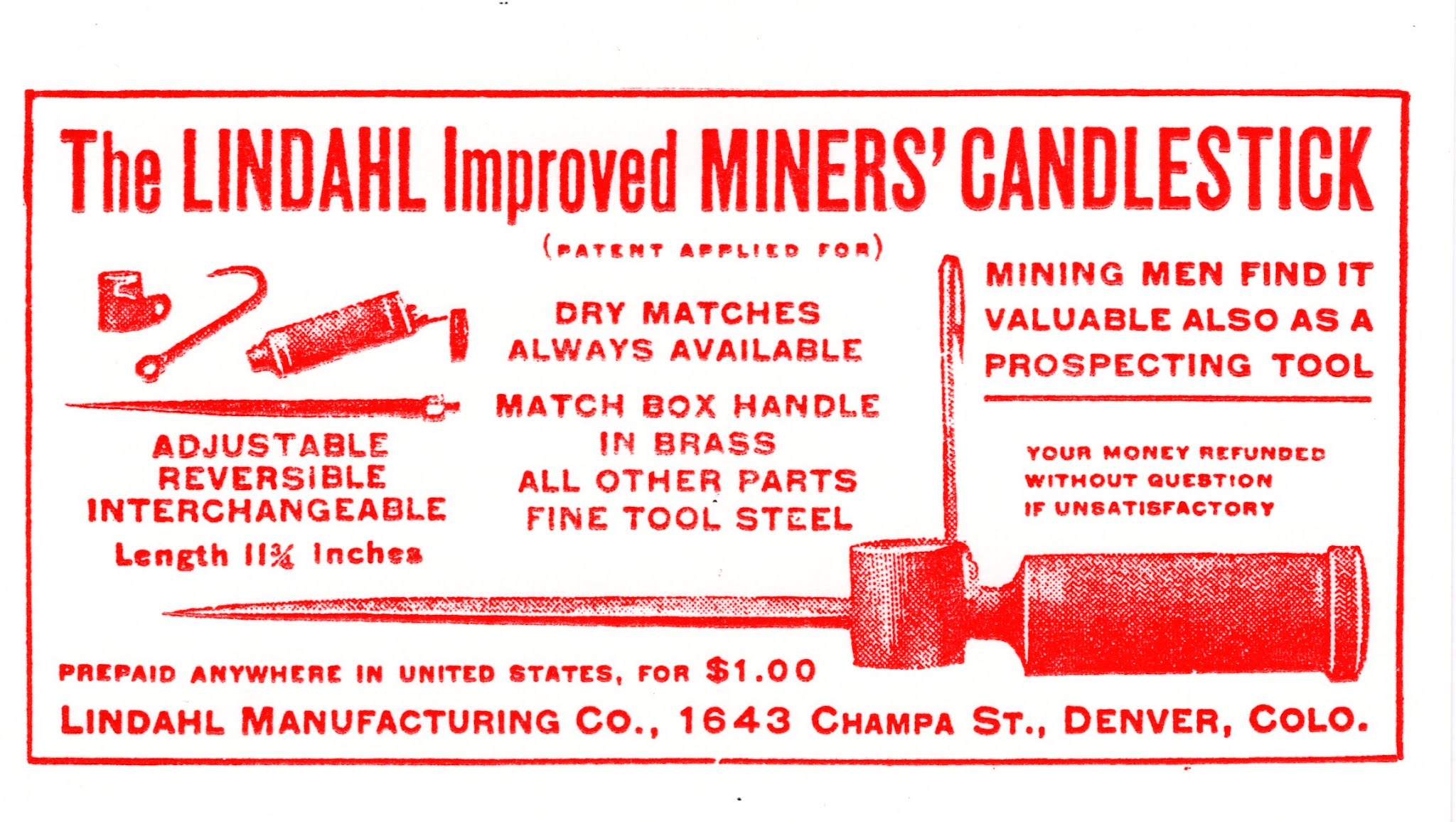
Figure 5. Advertisement for the Lindahl candlestick patented by John Lindahl in 1905. Lindahl lived in Colorado Springs. The candlestick was adjustable, reversible, interchangeable, and featured a case containing matches that replaced the loop handle in this model.
From the S.W. Veatch postcard collection. |
The two largest candlestick manufacturers were Nathan Varney of Denver and the Ludlow–Saylor Wire Company of St. Louis. A 1911 catalog advertised Varney candlesticks that cost six dollars per dozen (50 cents each). More elaborate candlesticks advertised in Mining Science in 1914 cost $1.50 each.
Candlesticks were simple, reliable, and easy to use. Cripple Creek miners used candlesticks for many years until carbide lamps and electric cap lamps made them obsolete in the early decades of the twentieth century.
Miners found other uses for candlesticks. Crafty high graders used a hollow area in the curved handles of specially made or modified candlesticks to conceal high grade gold ore with candle wax or mud before they went home (Pohs, 1995).With their sharp, piercing points, candlesticks were used as weapons to settle arguments in the heat of the moment (Gosling,1969). In 1903, Colorado’s governor James H. Peabody escaped being killed by an assassin at a meeting he was scheduled to attend. The assassin intended to use the spike of a concealed candlestick as the murder weapon. The governor skipped the meeting and instead enjoyed a football game at the Colorado School of Mines (Pohs, 1995).
Today, candlesticks can be found in private and museum collections. They are a symbol of the underground miner and the hard work he did.
Acknowledgments
I thank the Colorado Springs Oyster Club critique group for reviewing the manuscript, and Dr. Bob Carnein for his valuable comments and help in improving this paper.
References and Further
Reading:
Bartos, P., 2010, A light in the darkness:
U.S. mine lamps, the early years—candlesticks, oil lamps, and safety lamps: Mining
History Journal, vol. 17, p. 45-63.
Gosling, E. M.,1969, Miners’ Candlesticks:
Spinning Wheel, vol. 25, Jan-Feb, p. 21.
Pohs, H. A., 1989, Early Underground
Mine Lamps: Mine Lighting from Antiquity to Arizona: Museum Monograph No. 6,
Tucson, Arizona Historical Society, p. 7-16.
Pohs, H. A., 1995, The Miner’s Flame
Light Book: Denver, Flame Publishing Company, p. 121-214.
Ramsdell,
J. and N. S. Wagner, 1982, Patents, Miners’ Candlesticks: Carson City,
NV, privately published.
Weicksel, S., n.d., Mining Charity,
Retrieved from https://americanhistory.si.edu/fr/node/47976 on 5/18/2021.
Wilson, W. E. and T. Bobrink, 1984, A Collector’s Guide to Antique Miners’ Candlesticks: Tucson, The Mineralogical Record.