Showing posts with label Florissant Fossil Beds National Monument. Show all posts

Wednesday, March 5, 2025

A Florissant Fossil for the White City


by

Steven Wade Veatch

 The “Big Stump” at Florissant Fossil Beds National Monument, Colorado is one of the larger petrified stumps exposed in the Monument: it measures 3.6 meters tall and is 3.7 meters in diameter at breast height (Meyer, 2003). This solitary petrified stump is all that remains of a tree that was more than 60 meters tall when a volcanic mudflow (lahar) buried its base during the late Eocene.

Figure 1. This postcard, ca. 1894, shows a wooden framework
built around Big Stump. From the E. Simmons collection.

Big Stump is similar to the modern Sequoia (redwood) and is the type specimen described by Andrews in 1936 for Sequoioxylon pearsallii. An often-confusing aspect of paleobotany is that different organs (e.g., wood and leaves) that belong to the same living species are sometimes preserved isolated and unattached, in the fossil record. Therefore, it can be difficult to prove that they belonged to the same living species. For that reason they are sometimes given different names as fossils. At Florissant, Sequoioxylon pearsallii is the name assigned to the fossil wood and Sequoia affinis is the name for cones and foliage. They likely belonged to the same species of tree when they were living, but this cannot be proven unless these organs can be found attached in the same fossil. Philosophies differ, however, and in 1953 MacGinitie placed Sequoioxylon pearsallii into synonymy with Sequoia affinis. (Synonymy in the fossil record refers to the situation where two or more scientific names have been applied to the same fossil taxon.)

The Big Stump has been depicted in early photographs and postcards that date back to the late 1890s. Geologist Arthur Lakes, on an early expedition to the area with paleontologist Samuel Scudder, marked the location of a "petrified forest" on his original watercolor map in 1878—the general area where Big Stump is situated.

Figure 2. A broken and rusted saw blade remains wedged
in Big Stump from an attempt to cut it into sections and ship it to
Chicago for the World’s Fair. Image date 2003 by S. Veatch.

There was once a local effort to send this incredible fossilized tree stump to the World's Columbian Exposition (The Chicago World's Fair) of 1893. A plan was made in 1890 to remove the stump, transport it to Chicago by rail, and then rebuild it at the fair. Fortunately, the attempt to remove Colorado's prized fossil was unsuccessful. As it happened, the workmen’s saw blades became permanently wedged in the fossil wood. The plans to send Florissant’s famous stump to the Columbian Exposition were then quickly abandoned.

The World’s Columbian Exposition, one of the greatest cultural events of the nineteenth century, was named in honor of Christopher Columbus and celebrated the 400th anniversary of his arrival in the New World.

Figure 3. This ticket admitted the bearer into the World’s Columbian Exposition
in Chicago, a landmark event in American history and culture.
From the Michele Veatch Collection. 

Thousands were employed in the development of 633 acres of fairgrounds and the construction of 200 buildings in Chicago’s Jackson Park. Many of the fair buildings were located along constructed waterways fed by Lake Michigan. The Court of Honor buildings (14 main buildings) were covered in white stucco. Visitors, after seeing these white buildings, began to call this the White City. After three years of planning and building, and at a cost of twenty-eight million dollars, President Cleveland opened the fair on May 1, 1893. Ticket prices were 50 cents for adults and 25 cents for children.

Visitors to the Columbian Exposition enjoyed more than 65,000 exhibits and attractions. The fair contained many marvels and introduced Americans and the world to picture postcards, carbonated soda, hamburgers, and a gigantic wheel (built by George W. Ferris Jr.) that visitors could ride. The fair also introduced the nation to the Pledge of Allegiance and a new holiday—Columbus Day.


Figure 4. View of the Colorado building at the
World’s Columbian Exposition. Stacks of petrified wood
appear to be on either side of the entrance
to this building. Photo from the Michele Veatch Collection.

Most of the states and territories had exhibits at the fair, including Colorado. The Colorado building had a wide variety of displays from the Centennial State. If Big Stump had been cut and quarried into sections, the Colorado building would have been a likely destination. Colorado Day was celebrated September 12 at the fair without Big Stump—Colorado’s famous fossil remained at the Florissant Fossil Beds, intact. Although Big Stump did not make it to the Columbian Exposition, other Colorado fossils probably made it to the fair, perhaps even fossils from Florissant. (See note below.)


Figure 5. Fortunately, Big Stump did not make it to the
White City but remains for visitors to the Monument
to enjoy. Image date 2003 by S. Veatch.

By its closing date on October 30, 1893, more than 27 million people had visited the White City. If Big Stump had been removed and displayed at the fair, this oddity of nature would have been lost. This magnificent fossil is now protected by the National Park Service, and visitors to the Florissant Fossil Beds National Monument can view Big Stump in its geologic setting.

 Note: Some photos of the Colorado building depict stacks of petrified wood by the entrance. Because the Big Stump didn’t reach the Columbian Exhibition, I think this petrified wood is from Florissant. I contacted the Field Museum to see if they still had some of this petrified wood. The Earth science curator said they had some unidentified petrified wood in the basement. I went to the Field Museum, met the curator, and examined this petrified wood. It was not fossil wood from Florissant. The origin of this wood in the museum’s basement is unknown. The wood in old photos of the Colorado Building might have come from Florissant and is no longer at the museum. We may never really know what became of the fossil wood in the photos or where it originally came from.

Acknowledgements

            I thank Bob Carnein for improving this manuscript. I also benefited from many discussions of the Big Stump with park ranger Jeff Wolin. I dedicate this article to him.

References and further reading:

Andrews, H.N., 1936. A new Sequoioxylon from Florissant, Colorado. Annals of the Missouri Botanical Garden 23 (3): 439-446.

MacGinitie, H.D. 1953. Fossil Plants of the Florissant Beds, Colorado. Carnegie Institution of Washington Publication 599:1-198.

Meyer, H.W., 2003. The Fossils of Florissant, Smithsonian Books, Washington, D.C., 258 p.


Thursday, December 12, 2024

A Communion of Discovery

 Dedicated to Estella Leopold, conservationist. *

Melting ice washed gravels down,
burying the mammoth—hiding it through the ages.
And I found a rock at its grave, 
with secrets deep inside.
I broke it, crushed it, sifted it;
dissolved it in a beaker, 
spun it by a centrifuge, 
and peeled back layers of time.


Now only hidden fossils remain:
Pollen grains and mossy spores—
once floating on an Ice Age breeze.


Now in that communion of discovery
these small fossils yield
the deepest glimpse through time
to the world before we came, and warn
of a future we must face—
while just outside forests change, 
species die,
and life recedes.

By Steven Wade Veatch

An imagined scene of the Ice Age mammoth
found at the Florissant Fossil Beds
created by the author using AI.


* Estella Leopold assisted me in the actual paleontological research mentioned in this poem. A sediment layer associated with the burial site of a Columbian Mammoth at the Florissant Fossil Beds National Monument was found to contain Ice Age pollen and spores. This research resulted in a paper presented at the Geological Society of America in Denver in 2013. Estella was one of the original “Defenders of Florissant” and was instrumental in the Florissant Fossil Beds in becoming a national monument. Estella is the daughter of Aldo Leopold, who wrote the Sand County Almanac. Estella passed away February 25, 2024. She was 97 years old. 

Note: this poem is an expanded version of an earlier poem entitled "Mammoth" by the author.


Saturday, May 6, 2023

The Florissant Fossil Beds National Monument, Colorado: A Place of Change

 By Steven Wade Veatch

In 1965—when I was a boy—I picked up a chunk of petrified wood (about 34 million years old, or Late Eocene age) at the Florissant fossil beds and wondered how it was formed. This simple act changed my life: it started me on my lifelong hobby of collecting rocks, minerals, and fossils, and later influenced my decision to study science at college. Both were big and long-lasting changes in my life.

Steven Veatch (11 years old) and his brother Greg Veatch (4 years old)
sitting at the fossilized Big Stump at the fossil beds in 1965.
This was when the park was a private tourist enterprise. 

Years later, I experienced another transforming moment—meeting legendary scientist Estella Leopold at the fossil beds. On that special day, Estella and I ambled along the trail to the petrified stumps, deep in our thoughts. We plunked down on a park bench and chatted the afternoon away while sharing the excitement of Ice Age pollen discovered in a Pleistocene rock layer at the fossil beds. We shared a singular purpose then—to reveal a part of the Ice Age here at the fossil beds. Because the record of Ice Age pollen in the Rocky Mountains was limited, our work on Florissant’s Ice Age pollen was important. 

The Florissant Fossil Beds is also a place of change. Its landscape is a mosaic of montane forests and rich meadows enfolded in ever-shifting patterns of light, sound, and fragrance. It is a gateway to nature, to the past, and to the present. It is a tale of imagination, of scientific exploration, and of the Ute people. Whenever I visit, I find myself sinking mindlessly into its petrified past while I ponder its present.

The natural beauty at the fossil beds is also an invitation to explore its possibilities, to plunge into the forest and consider the flight of pollen grains, borne on a morning breeze. Or to follow a moss spore’s journey. Water moves slowly through Grape Creek. Moss-covered boulders slow the creek, making small pools. Gnats flutter above the creek, and green grasses, dotted with wild iris and other wildflowers, line its banks. Springs, coming from deep inside the ground, help feed the watercourse. I can feel this stream and its sounds deep within my soul. It is sublime.

Grape Creek in the fall. This creek runs through the monument.
Photo date 2018 by S. W Veatch.

My wife and I walk the forest trails often, and the landscape feels alive. Beard lichen’s wiry hair drops from forked branches. Chickadees and woodpeckers live with owls, deer, and black bears. There is a forest symphony of sounds composed of hums, trills, chatters, and peeps. Frogs call their mates. Wind stirs through the trees, rustles branches, and knocks down yellow mists of ponderosa pollen.

Black Abert squirrels leave a litter of chewed cones and tiny twigs, stripped of their bark, on the ground. In the winter, these cones, seeds, and twigs lie on the snow, showing that these squirrels do not hibernate. In the spring, pasque flowers poke up through the fallen pine needles and bloom in a soft lavender.
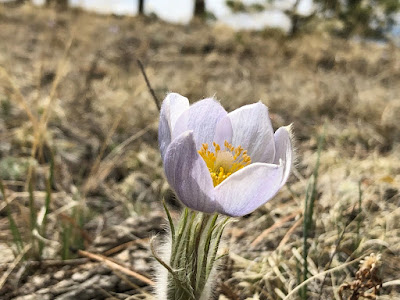
A pasque flower, a harbinger of spring, blooms
at the Florissant Fossil Beds.
Photo date 2019 by S. W. Veatch.

I notice the slow changes to a rotting log on the fossil bed’s forest floor. The log shows the passage of time on a different scale: the time it takes for a big, downed tree to be transformed back into soil—two centuries, or about seven human generations. 

Brimming with life, the log—now crumbled bits and pieces of wood covered with leaf litter—is a habitat for many species. Beetles chew the wood, forming serpentine galleries beneath the bark. Colonies of ants live in the cavities, forage for food, and remain subordinate to the mother queen. A mouse lives beneath the log’s rotting roots; fungal strands penetrate the decaying wood. Patches of lichen and moss grow green on its surface. Spiders spin webs on spindly branches. 

The log is now a spongy, mossy mound that once was a living tree. In this thriving microcosm of decay-dwelling species, there is a quiet yet energetic chemical factory recycling nutrients and organic matter. Altogether, this log, and others like it, nurture the forest by adding nutrients that sustain its health. And so it is that this landscape “nurses” my spirit.

There are other beneficial changes at the fossil beds. A combination of lightning strikes, a dry forest, and dry winds can cause a wildfire, which spreads across the landscape, bringing sudden change. Ponderosa pines are resistant to fire due to their thick bark and limbs that extend above the forest floor. Fire maintains the ponderosa pine forest by killing off competing trees. The ash from wildfires revitalizes the forest. 

Change at Florissant comes in many ways with the cycles of day and night. The red dawn splashes the sky with morning possibilities. The midday sun floods the valley with brightness while the spires of green trees poke at the sky. Wavering shafts of afternoon sunlight reach the forest floor. After sundown, the twilight spreads like ether, and the mountains cool like stone while the valley fills with a flood of moonlight. The stars become pinpricks that sizzle in the night sky.

The circling seasons of the sun, snow, and rain bring change on a longer scale. Summer sunlight falls from unbelievably blue skies. There is music in the rain as it slaps aspen leaves, bounces, and splats on the ground before it disappears into the soil. In the fall, the air is crisp, and the aspen leaves are a brush stroke of radiant gold and orange. In the winter, elk weave tracks across snowy slopes. Coyotes send their penetrating calls bouncing across the white meadows when the frosty night comes on.

Raindrops bead up on fallen aspen leaves at the park.
Photo date 2004 by S. W. Veatch.

Physical processes, such as the imperceptible progress of drifting continents, erosion, soil formation, or freeze-thaw cycles, bring change. And there are more rapid agents of disturbance—such as nearby volcanic eruptions that occurred 34 million years ago. These cataclysms sent flows of mud coursing down the river valley, forming a dam and lake that transformed organisms into fossils. The mud also surrounded the bases of trees, and, over time, petrified them. 

Today, petrified stumps stand like sentinels in the forest. Lichens cling to petrified wood like starfish on rocks. Kingdoms of moss stake their claims on fossil tree stumps. Whenever I hold a Florissant fossil or look at a stone stump, I experience the physical vastness of time and space.

A National Park Service archaeologist points out a peeled or
culturally modified tree at the monument. The Utes used
the bark for cradle boards and scraped the cambium layer
for food and medicine. Photo date 2004 by S. W. Veatch. 

Cultural change is a part of the fabric of this land of petrified forests and fossils. This was first the home of the Ute people, where their elders said you could learn a lot from listening to the land. The land was taken from the Utes, and these people were sent to less desirable places to subsist. I find evidence of these people today in the trees they modified or by finding an occasional arrowhead that is washed to the surface by summer rains. Roads brought homesteaders, who worked the land. Nearby goldfields intensified settlement. 

Lastly, the values of people change. After decades of being a commercial tourist attraction, people wanted to preserve the fossil beds. Activists, including Estella Leopold, helped to prevent the destruction of the fossil beds until the National Park Service could preserve the area for future generations. Outside the park, the forest and meadows were plowed under by bulldozers, subdivided, and further broken up by lots, fences, and roads. 

Advertisement for one of two tourist establishments
at the fossil beds circa 1965. Two tourist operations operated
at the fossil beds before it became a national monument.
From the S. W. Veatch collection.

Forests change, species evolve, and life proceeds. Today, the beauty of this place invites overuse, while the effects of climate change threaten the fossil beds with future habitat destruction and species extinction. 

For me, the Florissant landscape is a sacred place: A place of change, a place to meditate and scribble in a journal—a place to gain insight into how to live my life. It positioned me to think about time and change, to peer into the past and imagine the future. And to feel the present while I reflect on life, death, order, disorder, continuity, and change.


Friday, September 30, 2022

Fossils

By Steven Wade Veatch


Mammoth bones,
petrified trees,
insects trapped in amber,
pine pollen, a moss spore,
impressions in paper-thin shale,
stony steps of a dinosaur trail.

Just fragments of time,
puzzling pieces, vestiges
in layered ground:
A kingdom come,
a realm now gone,
past worlds in stone.

Fossil branches of the Florissant redwood, Sequoia affinis. 
Specimen FLFO-4858 from the collection
of Florissant Fossil Beds National Monument. 
Image date Oct 2003 by S. Veatch.


October 12th is National Fossil Day! 


Thursday, September 29, 2022

A Tree through Time

 By  Steven Wade Veatch

Thirty-four million years ago on a dismal Eocene afternoon near present-day Florissant Fossil Beds National Monument in central Colorado, woodland creatures fled as the ground shook from a fiery power held deep within the Earth. This dark force manifested on the surface, where toxic gases, ash, and molten rock shot through open vents —filling the air. A red glow painted the sky as cinders rained down through the smoky, sulfurous air onto the landscape. Flows of searing lava, which can reach 2,000 degrees Fahrenheit, oozed from volcanic vents, burning everything in their path. 

Following this concentrated chaos, hot ash and mud raced down the slopes of several volcanoes. Swirling mudflows pulled in surface materials, knocked down and carried small trees with their root wads, and then surrounded the bases of towering redwood trees. 

After frequent periods of active eruptions, the volcanic complex ultimately quieted down to dormancy and peaceable extinction. The mud that encased the bases of the redwoods enabled the slow petrification process to begin. The wayward mudflow also dammed a prehistoric stream and quickly formed a lake. Plants, insects, and other organisms were trapped in the lake sediments. As time passed, the lake sediments turned into shale containing fossils of these organisms.

Today, enormous redwoods grow at their ecological limit in a narrow zone along the California and Oregon coasts. Redwoods still exist at the Florissant Fossil Beds National Monument, but only as fossil leaves, cones, or petrified stumps. It would be impossible for redwoods to grow today in Florissant’s cool, temperate highland climate. Redwoods reached towering heights in Florissant’s Eocene past, when the climate was warm and temperate.

* * *

There is a remarkable site at the monument where a singular fossil redwood stump endures despite the unavoidable and inexorable power of erosion and weathering. This petrified redwood base is unique among the others: It has a ponderosa pine tree growing from its stone center. I have always been spellbound by this juxtaposed image—the prehistoric stone stump with a living ponderosa tree growing out of it. I wanted to look at it again and make a deeper connection with this geological marvel. 


A living ponderosa pine tree grows
 from an ancient redwood that has turned
to stone. Photo date 2013 by S. S. Veatch.

As I walked on a trail to its location, Pikes Peak loomed in the distance. I passed a long, low, grass-covered meadow bounded by treed hills.  A green swath of lichen-capped rocks fringed the trail. As I neared the scene I sensed a weight to the afternoon: windy weather brought a grey, clouded sky that rolled over the land. The warm, heavy smell of rain soon rose from the wet and glistening forest floor. Glittering drops of water rested on leaves. The wind began to whistle through the trees while flowers of sky-blue flax nodded. As the rain clouds broke up, an elk wandered this high stretch of land while a coyote trotted by. 

A blue flax blossom at the Florissant Fossil Beds
National Monument. Photo date 2003 by S. W. Veatch.

When I reached the fossil redwood, I sat down on a bench to soak in the experience.  As I looked at this remarkable remnant of a primeval redwood I noticed patches of soft, velvety, emerald green moss gripping sections of the petrified stump. There are small forest sounds: a bird chirps in the distance while a chickadee croons a love song from a place deeper than daydreams. A jay scolds me from the safety of a high branch overhead. There are little rustlings in a tree behind me where a black, tufted eared Abert’s squirrel worries a pinecone. These sights, sounds, and smells make me content, and mark this natural place as special. 

* * *

Fossils are the letters that form words in a geologic story.  Together, these words complete the pages of the area’s paleontological record: messages from a distant time telling a story of plants and animals that once lived here and are now gone. The pages document the broader climate and the ecosystem it supported. Most importantly, these intimate histories—written in stone— yield a narrative of how an ecosystem responds to climate change. The Eocene marks the start of a gradual global cooling.

The secrets of deep time are exposed in fossils on pine covered hills and grassy meadows of Florissant.  At the Florissant Fossil Beds lie some of the world’s richest fossil deposits, remnants of life ranging in size from a tiny grain of pollen to massive redwood trees. Time is no longer the trickster under Florissant’s vast summer sky; instead, time is captured as a memory in each fossil and is brought forward to the present, where these vital fossils reveal a primeval Eocene ecosystem. I immersed myself in its story.  


Big Stump at the Florissant Fossil Beds National Monument.
Photo date 2020 by S. W. Veatch.


Wednesday, September 21, 2022

A Communion of Discovery

Dedicated to Estella Leopold, conservationist


Melting ice washed gravels down,
burying the mammoth—hiding it through the ages.
And I found a rock at its grave,
with secrets deep inside.
I broke it, crushed it, sifted it;
dissolved it in a beaker,
spun it by a centrifuge,
and peeled back layers of time.
 
Now only hidden fossils remain:
Pollen grains and mossy spores—
once floating on an Ice Age breeze.
 
Now in that communion of discovery
these small fossils yield
the deepest glimpse through time
to the world before we came, and warn
of a future we must face—
while just outside forests change,
species die,
and life recedes.


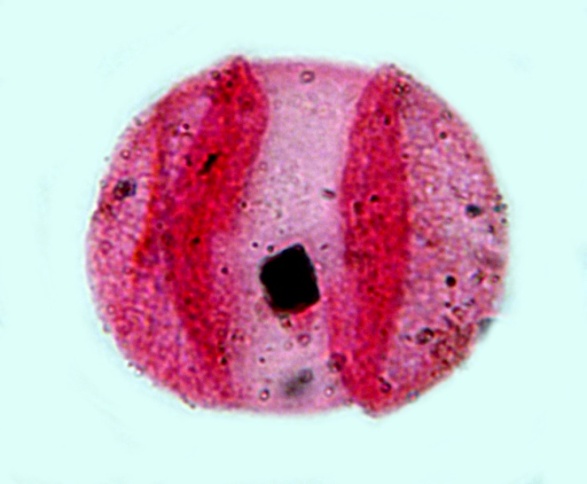
Spruce (Picea) palynomorph from the
Florissant Fossil Beds National Monument,
image by David Jarzen.


Estella Leopold assisted me in the actual research of Pleistocene pollen from Florissant. A layer associated with the burial site of a Columbian Mammoth at the Florissant Fossil Beds National Monument was found to contain Ice Age pollen and spores. This research resulted in a paper presented at the Geological Society of America in Denver in 2013. Estella was one of the original “Defenders of Florissant” and was instrumental in the Florissant Fossil Beds in becoming a national monument. Estella is the daughter of Aldo Leopold, who wrote the Sand County Almanac.


Tuesday, June 18, 2019

Timeless Trees at Florissant, Colorado

The huge petrified Sequoia stumps near Florissant stretch the limits of my understanding. I’m left with only wonder, like a poem I can’t explain. Under the dominion of a clear blue sky, the afternoon light ricochets off the stone, displaying the myriad beige and brown hues of the fossil stumps. Their stony surfaces contrast with tufts of grass that surround them. The nearby orange-red bark of ponderosa pine and the scent of the forest adds another layer of magic, while silent mats of pine green moss cluster in the shadows.  Pale lichens cover some of the stone tree rings.  The warm summer air buzzes with insects.

Figure 1. View of the Florissant Fossil Beds National Monument's 
iconic "Big Stump." Photo by S.W. Veatch.
For me, the stone trees are a portal where the past joins with the present, and time seems to have stopped.   I imagine how it all began 34 million years ago when a cluster of nearby volcanoes, once dormant, erupted.  It started with a blast of ash and fiery molten rock shooting out from awakened vents. The air became heavy and dark, as plumes of grey ash hazed eastward towards what would become Florissant. Rainfall mixed with loose sediments on volcanic slopes, forming mud—the color of morning coffee—that rushed down the slopes of the volcanoes at speeds of up to 90 miles an hour. Ash rained out of the sky and mixed with the spreading mud. The mud popped and hissed, while it spilled over ledges, covered rocks, and stretched heedlessly into the Florissant valley.

A wreckage of plants and animals tumbled in the mud’s advance as it invaded the forest of tall Sequoias. It turned the area into a surreal, harsh, hellish place, wiping out local populations of oreodonts, rhino-like brontotheres, and small horses. Birds, struggling to dodge the devastation, flew skyward from the branches of trees that stood above the mud. Tendrils of steam rose out of the jumbled mess of mud that surrounded the bases of the trees. The weight of the mud pressurized and squeezed the wood.  Over time, silica in the mud penetrated the wood, leaving behind the remnants of the ancient forest we encounter today.

I first saw the petrified trees when I was in grade school. I came back often with my family to look at them again.  This relic stone forest changed me. I studied fossils and rocks because of them. And I learned from them. I now realize how mankind is a force of nature and how we can alter landscapes, just as the ancient mud and ash did so long ago at Florissant. Our addiction to fossil fuel has altered our planet’s atmosphere and contributes to changing global climate. Florissant’s Sequoias are extinct because of climate change, and these trees encourage us to contemplate our annihilation as the planet experiences rates of extinction not experienced since a meteor wiped out the dinosaurs.
         
At the stone stumps, I take a few minutes to listen, where the sounds of the chirping birds, chattering squirrels, and the soft whispers of breezes exist with the noises of development—homes being built, cars moving and dogs yapping. I can also hear the petrified forest—it speaks of an Earth that is always in a state of change, but this protected ancient forest (a national monument now) also provides a place where change slows down, at least for me. As I look at the fossilized trees, I sense a calm as they release me from my ego and create an awareness of the wonderful things I can discover outside of myself.         

Figure 2. Dynamite was used the early twentieth century to expose this stump.
The use of explosives resulted in the shattered texture of the stump and
required the use metal bands to hold it together. Photo by S.W. Veatch.


Friday, July 20, 2012

A Short Note on Fossil Spiders from Florissant

The order of Araneae (true spiders) are represented as a large and diverse group in the 34.1 million-year-old Florissant Formation. Spiders were among the earliest animals to live on land. They are thought to have evolved about 400 million years ago from primitive ancestors that emerged from water to live on land. Spiders are arachnids—not insects, however both spiders and insects belong to the largest group of animals on Earth, the arthropods.


Differences Between Spiders and Insects

Feature                        Spiders                  Insects
Main body parts              2                           3
Walking legs                   8                           6
Eyes                              Simple                   Compound
Jaws                              Piercing (fangs)     Chewing
Antennae                        No                        Yes
Ability to fly                     No                        Most
Abdominal silk organs     Yes                       No

Figure 1. This Eocene-age fossil spider is a male, based on the swelling of the pedipalps. Many fossil spiders are impressions that are barely discernable.  Florissant Fossil Beds National Monument specimen number 2971A. Photo: R. Woods.  
Florissant is well-known for its fossil spiders. More than 150 specimens of spiders have been found in the Florissant shales (Kinchloe, 2003). Toni Clare, owner of the commercial quarry north of the Florissant Fossil Beds National Monument, collected the specimen shown in figure 1 in 1997. When spiders die their legs normally curl under their body (Meyer, 2003). Florissant spiders, including the specimen in figure 1, have their legs extended, rather than curled up. It has been argued that the extended legs of Florissant’s spiders suggest the waters of ancient Lake Florissant, during the latest Eocene, were warmer or more acidic than normal: the likely cause may have been from thermal vents associated with area volcanism or from ash falls (Meyer, 2003).

It is difficult to assign Florissant’s fossil spiders to a genus and species based on their external features observed in the paper shales. Since microscopic characteristics cannot be seen in the fossil impressions at Florissant, an outline morphometric study, using carapace (dorsal exoskeleton) shape and leg characters, has been effective in making family placements of fossil spiders (Kinchloe, 2004).

All spiders have two well-divided body sections: the cephalothorax (prosoma) followed by an abdomen (opisthosoma) (Grimaldi, 2005). The abdomen contains the digestive and reproductive systems and on the ventral surface near the apex are spinnerets that deliver small threads of silk. Silk has many functions such as making intricate webs that capture prey, encasing eggs, and building elaborate nests or burrows. Spiders with a distinctive silk organ, called a cribellum, are included in a special group called the Cribellatae. The fossil spider in figure 1 has a cribellum and belongs to this group (Rasnitsyn, personal communication, 2006).  The specimen in figure 1 has not yet been classified beyond the order.

Taxonomic Classification of Spider in Figure 1 (It is difficult to classify some of Florissant’s fossil spiders into higher taxonomic categories)


Phylum   Arthropoda
Class      Arachnida
Order     Araneae (spiders)

Spiders have eight walking legs, all attached to the cephalothorax. On the front of the cephalothorax are the mouth, fangs to bite prey with, and eyes. The first pair of appendages—the chelicerae—are used for piercing, handling prey, and injecting venom. The second pair of appendages, the pedipalps, are used for mating and are much larger in male spiders than in females.

All species of spiders are predatory—spiders that do not spin webs, such as wolf spiders and tarantulas, stalk or ambush their prey. Spiders feed by a process known as external digestion. When spiders catch an insect, they inject venom that paralyzes their prey. The spider’s venom also contains digestive enzymes. These enzymes liquefy most of its victim’s insides so the spider can feed on this mixture of nutrients (figure 2).


Figure 2. Yellow Garden Spider (Argiope aurantia), Wellington, Kansas.  Photo: © 2003 Joseph Hall.  Used with permission by Joseph Hall.
Spiders were once a part of an ancient ecosystem at Florissant that has long since vanished; the only record of it is held in the fossil beds. Some of the spiders that lived there built elaborate webs; several built tunnel-like lairs under rocks or under the dead leaves littering the primeval forest floor, while others lived on rocks or trees. Some of the spiders ultimately turned into fossils. More exciting discoveries of these remarkable fossils will no doubt occur and add to our understanding of this prehistoric ecosystem and these interesting creatures.
References Cited:

Grimaldi, D and Engler, M. S., 2005, The Evolution of Insects: New York, Cambridge University Press, 689 p.

Kinchloe, A. E., 2003, A taxonomic study of the Eocene spiders from Florissant, Colorado: Geological Society of America Abstracts with Programs, v 35, no. 6, p. 537.

Kinchloe, A. E., Smith, D.M., Cushing, P. E., and Gurlalnick, R., 2004, A morphometeric study of the Eocene spiders of Florissant, Colorado: Geological Society of America Abstracts with Programs, v 36, no. 5, p. 40.

Meyer, H.W., 2003, The Fossils of Florissant: Washington, D.C., Smithsonian Books, 258 p.

Rasnitsyn, A. P., [Russian Academy of Science], personal communication, June, 12, 2006,

Sunday, November 28, 2010

Fagopsis longifolia: an Extinct Species from Florissant

Fagopsis longifolia is one of the more common fossil plants found in the Florissant Formation. Located 35 miles west of Colorado Springs, Florissant Fossil Beds National Monument has one of the most diverse fossil deposits in the world—more than 1,700 different species have been described from this ancient lake deposit. Fagopsis, a genus that became extinct at the end of the Eocene, is thought to have been a member of the beech family (Fagaceae). Originally identified as the water elm, Planera, these fossil leaves were assigned to the genus Fagopsis.
Fagopsis longifolia is one of the most abundant fossils found in the Florissant Formation. The length of the leaves are 5 to7 cm (1.9 to 2.75 inches); and the width is from 2.5 to 3 cm (1 to 1.2 inches). Specimen FLFO3129a, Florissant Fossil Beds National Monument. Image by Russell Wood.
Fagopsis is known from just 30 other fossil specimens from the North American Eocene. Although Fagopsis longifolia is among the most abundant fossils at Florissant, this species has not been found anywhere else in the world. Fagopsis thrived along the prehistoric Florissant streams and the edges of ancient Lake Florissant, dropping its abundant leaves onto the water. Towering redwoods (Sequoia) also grew around the borders of the lake and along streams.

This brochure, featuring one of the Sequoia stumps of the Florissant fossil beds, was used to attract visitors to the fossil beds when it was a tourist attraction. Huge, petrified Sequoia trees are the largest fossils found in the monument—some have the largest diameter petrified trees known. Brochure image courtesy of the Beth Simmons collection.
Fossil plants, just like Fagopsis longifolia, provide important information about paleoclimate and the uplift history (paleoelevation) of the Rocky Mountains in the prehistoric past. Fagopsis represents plants found in a moister climate than the cool, dry climate of Florissant today. Based on characteristics of Fagopsis and other fossil plants, scientists have estimated the mean annual temperature at Florissant during the Late Eocene at approximately 10.7° to 14°C (51.2° to 57.2° F) with an estimated paleoelevation of 1,899 to 3,299 meters (6,230 to 10,500 feet) Note: there is counterevidence from non-floral studies that propose different mean annual temperatures and paleoelevations. Researchers are still working on this problem] Florissant also represents a time period just before a major cooling of the world’s climate that occurred during the end of the Eocene and at the dawn of the Oligocene .

Fossils of Fagopsis longifolia are found between layers of paper-thin lake shales in the Florissant Formation from the latest part of the Eocene (34 million years ago).  Most of the Florissant fossils are detailed compression and impression fossils of insects and plants. Image by Donald Miranda.
The conditions of ancient Lake Florissant led to exceptional fossil preservation and preserved a number of fossils—like Fagopsis longifolia—that are used by researchers as proxies or useful indicators for reconstructing ancient environments and understanding biological evolution, paleoclimate, paleoelevation, and climate change.


Sunday, November 21, 2010

Dryopteris: A Fossil Fern from Florissant

Ferns are among the fossil plants found in the Florissant Fossil Beds of Colorado. Fossil plants like these ferns are records of prehistoric life—providing information about when an organism lived, where it lived, and how it lived. Fossils are vital in helping paleontologists reconstruct ancient environments and establishing the geologic history of the Earth.

Dryopteris guyotti was abundant in past geologic ages. 
Broad, flat leaves helped the fern catch more sunlight.
Florissant Fossil Beds National Monument specimen
number 3135a.  Photo by R. Wood.
The origins of ferns are not well understood, but continued study of fossil ferns may reveal more about their beginnings. The earliest recognizable ferns come from the Carboniferous (359-299 million years ago).

Ferns have large complex fronds (leaves) and are spore bearers. Some ferns are non-woody, but other ferns are woody and are called tree ferns. Ferns were common late Paleozoic plants and widespread in the Mesozoic. Today ferns are the most common and diverse spore-bearing land plants with over 10,000 species. They generally live in moist, shady areas of the forest understory.

Dryopteris, from the Greek, drus (oak) and pteris (fern) occurs in Florissant’s Eocene fossil flora as well as other Tertiary floras. Its common name—wood fern—is from the preferred woodland habitat of most Dryopteris species. Other common names include shield fern, Goldie’s fern, male fern and buckler ferns.

Today Dryopteris is a genus of about 250 species of ferns growing in the temperate Northern Hemisphere and in eastern Asia. Fronds are bipinnate (branching of leaflets at right angles to the central axis). The leaflets, or pinnules, are lobed. Fertile pinnules have round sori, which are fruit dots or reproductive bodies (Tidwell, 1998). Many of the species have solid rootstocks forming a crown with a ring of fronds.

Line drawing of Dryopteris filix.
Note round sori near top.
USDA-NRCS PLANTS Database
 Britton, N.L., and A. Brown. 1913.
An illustrated flora of the northern United States,
Canada and the British Possessions.
Off all the fossil ferns at Florissant, Dryopteris guyottii is the only species of fern described from a frond. Other ferns are known only from fossil spores. It appears that Dryopteris guyotti grew in the understory of the Eocene forest at Florissant (preferring damp and shaded environments like its modern relatives) or near ancient Lake Florissant.

Sunday, November 14, 2010

A Short Note On: Fossil Spiders from Florissant

The order of Araneae (true spiders) are represented as a large and diverse group in the 34.1 million-year-old Florissant Formation. Spiders were among the earliest animals to live on land. They are thought to have evolved about 400 million years ago from primitive ancestors that emerged from water to live on land. Spiders are arachnids—not insects, however both spiders and insects belong to the largest group of animals on Earth, the arthropods.


Florissant is well-known for its fossil spiders. More than 150 specimens of spiders have been found in the Florissant shales.

This Eocene-age fossil spider is a male, based on the swelling of the pedipalps. Many fossil spiders are impressions that are barely discernable.  Toni Clare, owner of the commercial quarry north of the Florissant Fossil Beds National Monument, collected the specimen shown above in 1997. Florissant Fossil Beds National Monument specimen number 2971A. Photo: R. Wolf.
When spiders die their legs normally curl under their body. Florissant spiders, like the image of one above, have their legs extended—rather than curled up. Scientists argue that the extended legs of Florissant’s spiders suggest the waters of ancient Lake Florissant, during the latest Eocene, were warmer or more acidic than normal; the likely cause may have been from thermal vents associated with area volcanism or from ash falls.
It is difficult to assign Florissant’s fossil spiders to a genus and species based on their external features observed in the paper shales. Since microscopic characteristics cannot be seen in the fossil impressions at Florissant, an outline morphometric study, using carapace (dorsal exoskeleton) shape and leg characters, has been effective in making family placements of fossil spiders.

All spiders have two well-divided body sections: the cephalothorax (prosoma) followed by an abdomen (opisthosoma). The abdomen contains the digestive and reproductive systems and on the ventral surface near the apex are spinnerets that deliver small threads of silk.

Silk has many functions such as making intricate webs that capture prey, encasing eggs, and building elaborate nests or burrows. Spiders with a distinctive silk organ, called a cribellum, are included in a special group called the Cribellatae. The fossil spider in figure 1 has a cribellum and belongs to this group.

Spiders have eight walking legs, all attached to the cephalothorax. On the front of the cephalothorax are the mouth, fangs to bite prey with, and eyes. The first pair of appendages—the chelicerae—are used for piercing, handling prey, and injecting venom. The second pair of appendages, the pedipalps, are used for mating and are much larger in male spiders than in females.

All species of spiders are predatory—spiders that do not spin webs, such as wolf spiders and tarantulas, stalk or ambush their prey. Spiders feed by a process known as external digestion. When spiders catch an insect, they inject venom that paralyzes their prey. The spider’s venom also contains digestive enzymes. These enzymes liquefy most of its victim’s insides so the spider can feed on this mixture of nutrients.

Spiders were once a part of an ancient ecosystem at Florissant that has long since vanished; the only record of it is held in the fossil beds. Some of the spiders that lived there built elaborate webs; several built tunnel-like lairs under rocks or under the dead leaves littering the primeval forest floor, while others lived on rocks or trees. Some of the spiders ultimately turned into fossils. More exciting discoveries of these remarkable fossils will no doubt occur and add to our understanding of this prehistoric ecosystem and creatures.

Sunday, November 7, 2010

Aerial Photos Shows Outline of Ancient Lake Florissant

Just west of Pikes Peak and south of the town of Florissant, Colorado (about 40 miles west of Colorado Springs on U.S. Highway 24) lies a scenic mountain valley where a number of petrified redwood stumps dot the landscape. Beneath this beautiful setting are incredible plant and insect fossils buried in the sediments of an ancient lake. These fossils, ranging from large tree stumps to single-celled diatoms, reveal a prehistoric Colorado of long ago. Today the Florissant Fossil Beds National Monument protects these fossil resources.

About 34 million years ago, volcanic eruptions near Guffey (18 miles to the southwest) produced volcanic mudflows (water-saturated mass of ash and rock debris). These mudflows—looking and flowing like concrete—buried a lush valley and petrified the bases of huge redwood trees that grew there. These mudflows also created a dam in the valley, forming a lake about one mile wide and 12 miles long. Volcanic ash from subsequent eruptions formed fine-grained sediments at the bottom of the lake. Plants, insects, and other organisms were entombed in this material. Over millions of years these sediments were compacted into layers of shale. The delicate details of these organisms were preserved as fossils and provide a look at the life and the prehistoric ecosystem of the Florissant valley during the end of the Eocene Epoch.

The approximate area of ancient Lake Florissant is defined in this aerial photo by meadows and treeless sections. The prehistoric lake area (light gray) is seen extending through the center of the photograph and then turns west at the town of Florissant. NAPP black and white vertical aerial photo from 20,000 feet (9/29/1999). Top of the photo is north.


NAPP vertical color infrared (CIR) aerial photo of the Florissant valley from 20,000 feet (9/24/88).  Color infrared film is used to interpret natural resources such as vegetation, soil conditions, water resources, and other features.  Active vegetation appears in various shades of red and pink (intense red colors indicate vigorous and dense growth).  Water that is clean and clear appears black.  Shallow water reflects bottom sediments and appears in various shades of blue. Soil conditions (moisture levels) are revealed by the degree of the gray tone:  dry soils are light gray, moist soils are gray, and wet soils are dark gray.  Top of the photo is north.